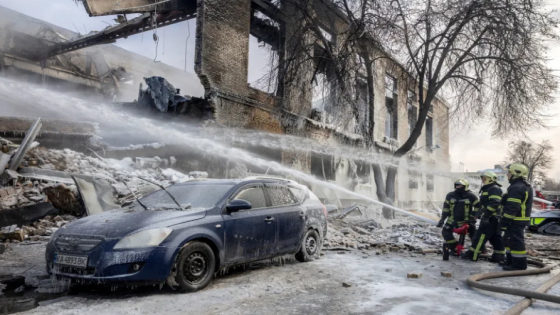
Kyiv / Moscow – January 14, 2026
As Europe and parts of North America grapple with one of the harshest cold snaps in years, Russia has dramatically escalated its long-running campaign against Ukraine’s civilian infrastructure. In the early hours of January 13–14, 2026, Russian forces carried out what Ukrainian officials describe as the largest combined drone and missile barrage targeting the country’s energy system since the winter of 2022–2023.
According to Ukraine’s Energy Ministry and grid operator Ukrenergo, more than 120 missiles and 90 Shahed-type drones struck at least 15 high-voltage substations, several thermal power plants, and gas infrastructure facilities across 11 oblasts. The result has been catastrophic:
- Over 1.2 million households (roughly 3 million people) are without electricity as of late January 14.
- Several oblasts—including Kharkiv, Sumy, Poltava, Zaporizhzhia, and parts of Kyiv oblast—have declared emergency blackouts lasting 12–18 hours per day.
- Critical heating plants in Kharkiv and Kryvyi Rih are either completely offline or operating at 20–30% capacity, leaving hospitals, schools, and residential buildings without heat in temperatures that have dropped to –18 °C in the east and –12 °C in central regions.
Ukrainian President Volodymyr Zelenskyy addressed the nation in an emergency video statement at 04:30 local time:
“Russia is deliberately trying to turn winter into a weapon against our people. They want to freeze us, to break our spirit. They will fail. We are repairing what they destroy, hour by hour. But the world must understand: every hour of delay in air-defense deliveries costs Ukrainian lives.”
Scale of the Attack – Largest Since Winter 2022–2023
Military analysts from the Institute for the Study of War (ISW) and DeepState UA confirm this was the heaviest single strike on energy infrastructure in almost three years. Key points:
- Kh-101 / Kh-555 cruise missiles launched from Tu-95MS and Tu-160 strategic bombers over the Caspian Sea and Engels airbase.
- Kalibr sea-launched missiles from Black Sea frigates.
- Shahed-136/131 “kamikaze” drones in multiple waves, overwhelming air defenses.
- Iskander-M and S-300/400 ballistic and anti-aircraft missiles repurposed as surface-to-surface weapons against ground targets.
Ukrainian Air Force spokesperson Yurii Ihnat reported that air defenses downed 62 cruise missiles and 47 drones, but acknowledged that “the sheer volume overwhelmed the system in several sectors.”
Humanitarian Impact – Winter Becomes a Weapon
Temperatures across eastern and central Ukraine have hovered between –10 °C and –20 °C for the past week, with wind chill making it feel closer to –30 °C. Without electricity:
- Water supply systems fail (pumps stop working).
- Mobile communication towers go offline.
- Hospitals switch to diesel generators with limited fuel reserves.
- Elderly residents and families with small children face life-threatening conditions.
The UN Office for the Coordination of Humanitarian Affairs (OCHA) issued an urgent flash appeal, estimating that an additional 1.8 million people could require emergency winter assistance in the coming weeks if power outages continue.
Western Response – New Aid Packages Announced
Within hours of the attack:
- United States announced an emergency $275 million package focused on air-defense interceptors and generators.
- Germany pledged 20 additional Iris-T SLM systems and €150 million for energy resilience.
- United Kingdom fast-tracked delivery of Storm Shadow missiles and Starlink terminals.
- European Commission President Ursula von der Leyen promised to “accelerate” the next €1.5 billion tranche of macro-financial assistance.
NATO Secretary General Mark Rutte called the strikes “a war crime targeting civilians” and urged allies to “remove all remaining restrictions on long-range weapons supplied to Ukraine.”
Moscow’s Justification
Russian Defense Ministry spokesperson Igor Konashenkov claimed the strikes were “precision attacks on military energy facilities used to support the AFU frontline.” He accused Ukraine of “using civilian power infrastructure to camouflage military production sites.”
Independent satellite imagery analysts from Planet Labs and Maxar, however, show that the majority of impacted sites are civilian substations and district heating plants with no visible military presence.
Why This Winter Attack Matters More Than Previous Ones
Unlike the 2022–2023 campaign, Ukraine now faces:
- Severely degraded air-defense stocks after two years of sustained Russian missile pressure.
- Record-low temperatures forecast to continue through late January.
- Fatigue among repair crews who have already restored the grid dozens of times.
Energy expert Oleksandr Kharchenko warned on national television:
“If Russia maintains this tempo for another 10–14 days, we may see permanent blackouts in several oblasts. This is no longer just infrastructure damage; it is an attempt to create a humanitarian catastrophe on European soil.”
The coming weeks will likely determine whether Ukraine can protect its remaining energy backbone or whether millions more civilians will spend the rest of the winter in darkness and cold.
What do you think will happen next in Ukraine this winter? Will Western air-defense deliveries arrive in time, or will Russia succeed in freezing the country into submission? Share your opinion in the comments!
Russia Ukraine war, Ukraine energy grid attack, winter blackouts Ukraine, Russian missile strikes 2026, Zelenskyy energy crisis, Europe cold wave 2026
“`