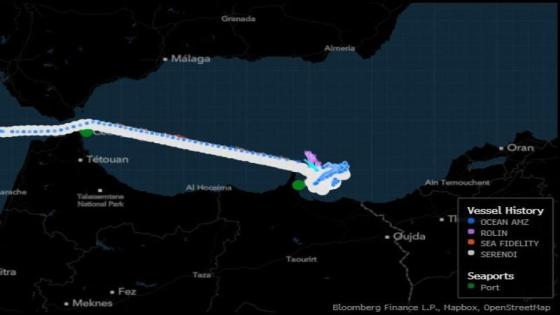
Morocco’s coast near Nador has become a new hub for Russian Urals crude oil transfers after Greece clamped down on the practice in its waters.
According to ship-tracking data consulted by Bloomberg, a Very Large Crude Carrier (VLCC) named Rolin is currently receiving Urals crude from a smaller tanker, the Serendi, off the coast of Nador. This marks the first instance of such transfers in this location.
The shift in location highlights the challenges of clamping down on this controversial practice. While European governments and regulators are wary of STS transfers near their coasts due to potential environmental and regulatory concerns, traders appear determined to find alternative locations.
Previously, Ceuta, a Spanish enclave bordering Morocco, served as a popular spot for Urals STS transfers.
However, pressure from local authorities and the European Union significantly reduced activity there over the past year.
Similarly, Greece’s recent naval maneuvers in the Laconian Gulf, a key location for Urals STS transfers following Russia’s invasion of Ukraine, seem to have been effective.
The International Maritime Organization (IMO), a UN body governing maritime regulations, has expressed concern over STS transfers in open waters, calling it a “dangerous practice.”
These concerns likely stem from potential environmental risks associated with oil spills during transfers at sea.
Additionally, STS transfers can be used to obscure the origin and destination of oil cargoes, potentially facilitating the circumvention of sanctions.
The vast majority, around 80%, of Russia’s Urals crude oil is destined for Asia’s powerhouses like India and China.
To make these long-distance journeys financially viable, oil companies rely on giant ships called Very Large Crude Carriers (VLCCs).
These behemoths offer significant cost savings compared to smaller tankers due to economies of scale – essentially, they can carry much more oil per trip, reducing the overall transportation cost per barrel.