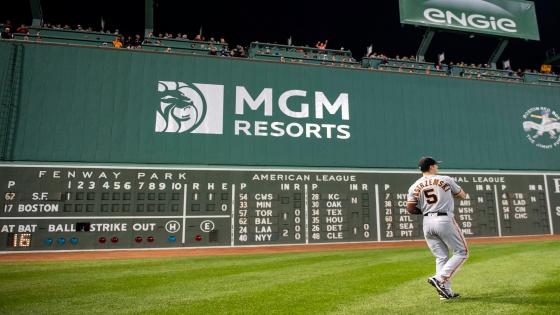
BOSTON — Whenever Mike Yastrzemski finds himself slowly sinking into the soft mud of a hitting slump, whenever he is repulsed by the sight of his batting average on the scoreboard in April, whenever he begins to feel that murmur of panic that stirs within every professional who happens to perform their trade in front of tens of thousands of spectators, he will find a quiet place and have a little self talk.
He’ll think of his family, which grounds him and gives him perspective. He’ll think of his track record of success, which offers a bit more. And whenever he needs a little extra grace, he’ll think of those three magical days in September five years ago.
Yastrzemski was a 28-year-old rookie and barely three months into a major-league career, one that began after so much exhausted hope, when the non-contending San Francisco Giants headed east to play out the string on the 2019 season. The midweek interleague series against the Boston Red Sox at Fenway Park ended up being a whole lot more compelling than that.
For the first time in 37 years, a Yastrzemski patrolled the grass in front of the Green Monster. Hard-bitten Red Sox fans who adored Mike’s grandfather, Hall of Famer Carl Yastrzemski, made the rare gesture of wrapping their arms around a visiting player as they cheered Mike’s first trip to the plate. They kept cheering him around the bases in his second at-bat, when he powered a home run to center field. A day later, Carl Yastrzemski made a rare public appearance and threw out a ceremonial first pitch to his grandson.
The entire series was dramatic. It was also draining and demanding.
Yaz to Yaz for the first pitch tonight: pic.twitter.com/BS61QNwio2
— Alex Pavlovic (@PavlovicNBCS) September 18, 2019
Mike Yastrzemski has had five years to process it. He still has a hard time accepting that it happened.
“Disbelief, you know?” he said on Saturday while standing outside the Giants’ indoor hitting cage. “I just can’t believe it played out how it did. Because there were so many times when I was ready to be done and I thought (his career) was over and I thought there was no chance it was going to happen. Then things start to unfold and that, right there, was the full-circle moment.
“As much as you want to continue to strive and be the best you can be, if it all ended with that day, it would’ve been enough. So it’s cool to continue doing it and have that opportunity.”
He’ll have the opportunity to do it again Tuesday night when the Giants begin their first interleague series in Boston since 2019. There are no plans for a ceremonial first pitch this time. The media requests won’t be quite so fervent. The ticket order for family and friends will be daunting but not overwhelming. If he hits a home run again, there might even be an audible boo here or there.
Mike Yastrzemski returns at a much different station in his career. He’s a five-year veteran now. He returns at a much, much different station in life. The grandson is now a father of two, including a newborn son, Michael (nicknamed Kai), who inherits a consonant-filled family legacy: the only son of an only son of an only son. Carl Yastrzemski’s count of great-grandchildren is up to eight. As of March 29, when Paige and Mike Yastrzemski welcomed a baby brother to join 3-year-old sister Quinley, Captain Carl, now 84, has a great-grandson who will carry forward his name.
The only disappointment this week is that Mike’s expanding family won’t be able to share the Fenway series with him. Little Kai, whose nickname is the Hawaiian word for ocean (where Mike popped the question), is too young to travel. So Paige and the kids will stay home in San Francisco and watch on TV.
“I’d love to have them there but the logistics would be pretty tough,” Mike said. “Hopefully we’ll have another go-around there and I can bring everybody and create some fun new memories.”

The Yastrzemskis embrace in 2019 after Carl threw out the first pitch at Fenway. (Brian Fluharty / USA Today)
The start of the season wasn’t so memorable for the Giants’ left-handed hitting right fielder. Mike followed up a cold spring with a .135 average and zero extra-base hits in his first 14 games. Despite some carping on social media from fans who wanted to see a younger outfielder like Luis Matos, there was never a chance that manager Bob Melvin would pull a ripcord on Yastrzemski so soon. He was still creating defensive value in right field. And his swing, as the coaching staff viewed it, was a matter of time to get hot.
Sure enough, in his past seven games, he is 8-for-18 (.444) with two home runs, including a solo shot that provided the winning margin in the Giants’ 3-2 victory over the Pittsburgh Pirates on Sunday.
“Definitely did not enjoy that scuffle,” Mike Yastrzemski said. “But as human beings, we have to give ourselves a little grace when we have a lot going on. There’s no excuse, no blame. I just wasn’t playing well. Now I’m feeling better and have some things dialed in and I’m happy with the way I’m swinging the bat. Right on time for the weather to start heating up.”
Yastrzemski laughed as he referenced the cognitive dissonance of a slow start. Every hitter will have a bad stretch of 10 or 20 games. It’s just magnified when it happens at the outset — especially if the previous season was a bit of a letdown, too. Last year’s 114 OPS+ was his best since 2020 when he finished eighth in NL MVP balloting. He also was limited to 106 games and under 400 plate appearances because of recurring hamstring injuries.
The doubts always grow louder for position players in their early- to mid-30s regardless of whether they were 28-year-old rookies who had to repeat Double A four times or whether they’re a perennial All-Star who won a Triple Crown.
Carl Yastrzemski’s age 32 season in 1972 was not so memorable, either. He battled wrist and knee injuries. He went more than 200 at-bats without a home run. He was hitting .164 when he hurt himself while sliding into home plate on May 9. And he was coming off a 1971 season in which his 113 OPS+ made him a solid regular but also represented a long fall from his MVP-level production in 1970 (fourth in MVP voting, 177 OPS+).
This is what Sports Illustrated wrote in May 1972:
“Today, going through a mood switch inching toward truculence, Yastrzemski has yet to concede that he is all washed up as a long-ball hitter, even if that opinion is the consensus at Fenway Park, where belief can run to fanaticism.”
And:
“While it remains to be seen if Yastrzemski’s power is gone for good at the age of 32, the critics’ case has merit.”
Captain Carl hit 183 home runs after 1972. He played 11 more seasons. The critics’ case didn’t have merit.
But that murmur had to flutter hard in Carl Yastrzemski’s chest, too. He was known as a constant tinkerer, always changing his swing and stance, dropping his hands, attacking every slump with a blue-collar mentality.
“I’m just a firm believer in changes,” he once told the Washington Post. “I’m not a big guy. I can’t be fooled, lose a hip or a hand and still do something with the baseball. Everything’s got to be perfect. I guess that’s why I’ve changed so many times over the years.”
More cognitive dissonance: If it seems that Yaz the elder was a large and imposing figure, that’s just a result of his outsized legacy. He was 5-foot-11 and 175 pounds. His tailored suit in 1972 could fit his grandson today.
Carl Yastrzemski never received relief from the expectations that accompany a Hall of Fame career. He was expected to be great all the time. If there was ever a time that Mike Yastrzemski felt pressure because of his name, that’s long passed. He’s made his own identity in the game and achieved more than he ever expected. He agreed with the notion that having that outlook allows him to be driven and hungry without being consumed by a fear of failure.
“There is a sense of that, yeah,” Mike Yastrzemski said. “As a competitor, you want to be the best and achieve everything you can, win World Series and MVPs. But at the end of the day, that’s not going to change how your family looks at you or how you go about the rest of your life. So just the fact I have this peace to cherish and enjoy is as much as I’ve ever needed.
“As I went through life, I had those moments where I’d say, ‘Is this for me or for my grandfather?’ And I just started to enjoy it, not take anything for granted and not try to dig too much into the whys. Just be happy and humble and accept the good things that come your way no matter the reason, because at some point, I might be able to pay it forward to someone else.”
Mike Yastrzemski and platoon partner Austin Slater will stage their Mustache May fundraiser again this season, growing out their Highway Patrol lip fuzz while selling merchandise to benefit their two charities. Yastrzemski is supporting Heart and Armor, which works to reincorporate military veterans into society and help them manage post-traumatic stress disorder. Slater’s cause, Bring Change to Mind, seeks to end the stigma and discrimination surrounding mental illness.
Slater already has a full mustache and beard so it’ll bear watching whether he attempts to get a head start on the competition. Yastrzemski didn’t try to cheat because his 3-year-old complains when he has a scratchy face.
That’s what happens when you become a dad. All your priorities change.
“Quinley’s starting to notice when I’m not home for a period of time,” Mike Yastrzemski said. “She’s definitely noticed that I play a lot of baseball.”
And this week, that’ll include three games in the shadow of the Green Monster.
“It’s where I fell in love with the game,” Mike Yastrzemski said. “I grew up idolizing those guys. When it came to baseball, it was only the Red Sox. That was my true love. I have such a passion for Fenway Park. You’d walk through the concourse and there would be people rustling everywhere, then you get to the crowd and it’s like this aura and buzz. It still sits with me to this day: That was the feeling I always wanted to feel when I played baseball.
“It’s just so cool that I get to go there and do it again.”
(Top photo of Yastrzemski from that 2019 Fenway series: Billie Weiss / Boston Red Sox / Getty Images)


