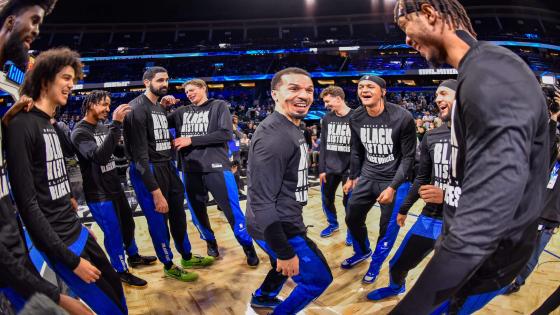
ORLANDO, Fla. — In one of the most heartbreaking moments of their season, Orlando Magic players revealed to the world what the team already knew.
They showed how much they care about each other.
Last Monday, in Game 2 of their first-round playoff series with the Cleveland Cavaliers, Magic starting point guard Jalen Suggs collided with Cavaliers’ guard Donovan Mitchell, causing Suggs’ left knee to buckle. The injury looked serious. Immediately after Suggs crumpled to the floor, he glanced toward the team’s bench as if to ask for help. Then he clutched his knee.
As medical staff members crouched over Suggs, all of the Magic’s reserves, ranging from baby-faced rookies Anthony Black and Jett Howard to 36-year-old veteran Joe Ingles, walked from their bench to the other end of the court to stand near their injured teammate and offer their symbolic support. They appeared crestfallen as Kevon Harris and Goga Bitadze helped Suggs off the floor. Reserve center Moritz Wagner, one of the players trailing behind, rubbed his fingertips on his temples, and appeared to fight back tears.
That snapshot in time, like so many additional moments the Magic can cite from the last three seasons, told a larger truth. In the modern NBA, where front offices can retool their rosters in one offseason and teammates sometimes cannibalize each other as they compete for their next contracts, this young Orlando team stands out as a refreshing anomaly. “I’ve been on two teams now,” center Wendell Carter Jr. recently said, “and I’m sure guys like Joe Ingles and Gary Harris can also agree with me when I say that I don’t think there’s a team like this in the league where everyone, one through 15, all like each other.”
This is more than a feel-good kumbaya story. It is also a success story. Orlando finished the regular season with a 47-35 record to earn the Eastern Conference’s fifth playoff seed. After losing their opening two postseason games amid a teamwide shooting slump, the Magic routed the Cavaliers on Thursday in Game 3 and on Saturday in Game 4 to tie the series at two games apiece.
Togetherness is the Magic’s superpower, even more than their positional size and their tough, physical defense. Perhaps they would not have recovered from their playoff-opening losses if they were not so close and had not built so much trust between each other. As coach Jamahl Mosley said, his players are “a group of guys that continues to pull for each other.”
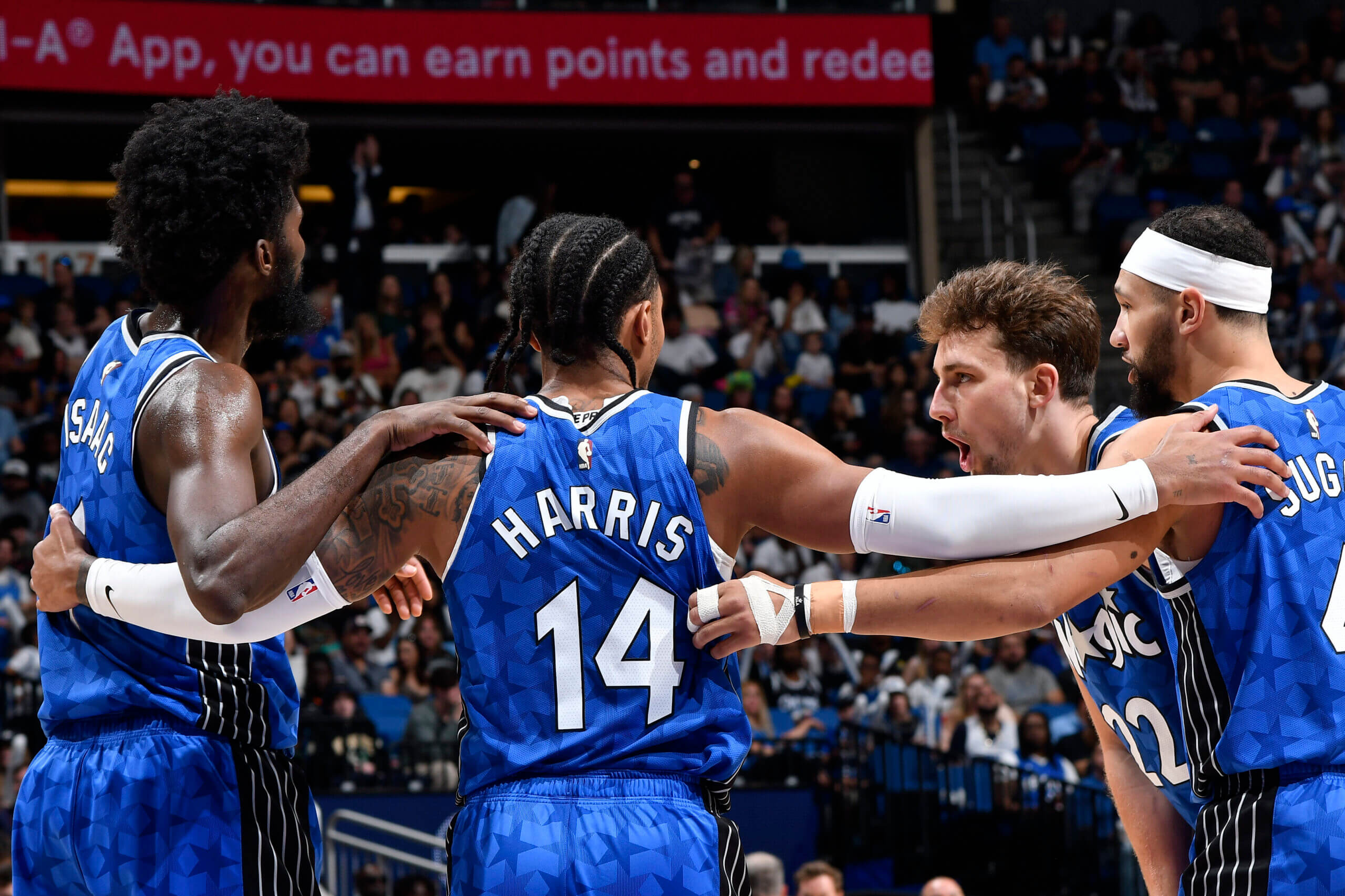
The Orlando Magic are a young team, but their camaraderie is next level. (Fernando Medina / NBAE via Getty Images / Courtesy of the Orlando Magic)
Paolo Banchero, a second-year forward, never expected his NBA career to begin quite like this. He had heard all the stereotypical stories about how professional players conducted themselves like mercenaries who prized their next big paydays above all else. But Banchero has been shocked to discover a different dynamic. He has compared the Magic to the idealized college teams of yesteryear, back when many players would remain at school through their junior or senior seasons and form tight bonds with each other.
He is not wrong. If you had watched Orlando play over the last three years, you would have seen the team’s players project a “rah-rah” vibe, with guys on the bench catapulting themselves off their seats to cheer on a teammate who had just made a hustle play.
“Obviously, guys do their own thing, but while we’re inside the facility, inside the walls, on the road together, it’s a family,” Banchero said. “That’s how I think we treat each other. It’s not cliqued-up or only this guy talks to this guy and that guy talks to this guy. Everyone is just together, and it makes it great.”
You can see and hear those friendships play out inside the Magic locker room before games and after victories. Brothers Franz Wagner and Mo Wagner, who grew up in Berlin, speak in English instead of German when they’re around teammates and almost always involve others in their conversations. Cole Anthony, Chuma Okeke and Bitadze often joke around, leaving their teammates in stitches. And Ingles, a grizzled Aussie who previously played on very good Utah Jazz and Milwaukee Bucks teams, trash-talks with just about everyone affiliated with the team but always does so with a wry smile on his face.
“I think the joy in what you see on the sidelines and the practices, shootarounds and the day-to-day is unique,” Ingles said without a hint of his trademark sarcasm. “I would be strongly confident that not every team is like this. Part of that is obviously credit to the organization for bringing in the right guys and (valuing) character. They’ve done a hell of a job because it’s a fun group.”
The selfless tone stems in part from several of the team’s longest-tenured players: Carter, point guard Markelle Fultz and Jonathan Isaac.
When the Magic needed to win their final regular-season game to clinch a playoff berth, Mosley moved Carter to the bench and made Isaac the team’s starting center. Carter did not pout; in fact, he was willing to sacrifice his playing time. When Isaac was helping the team go on a critical second-quarter run in the season finale and Mosley was preparing to sub Carter into the game, Carter told Mosley that Isaac should remain on the floor for the next few minutes because Isaac was helping the team.
“That’s the power of the group,” Mosley said after that game. “That’s the power of this team.”
And when Mosley decided to return Carter to the starting lineup prior to Game 3 of the playoffs to give Orlando a more physical post presence, Isaac supported the decision, team sources said.
Carter, Fultz and Isaac have something else in common: Each of them endured injuries early in the pro careers. Carter missed a large chunk of his rookie season with the Chicago Bulls after a thumb injury required surgery. Fultz faced thoracic outlet syndrome, which wreaked havoc with his jump shot, and later endured an ACL tear. Isaac missed the entire 2020-21 and 2021-22 seasons because of a serious knee injury.
“We don’t take anything for granted anymore,” Carter said.
“We want to score, but sometimes when that isn’t going for us, we’ve made a testament to one another that we’re going to do things that affect the game in different ways. Like if our shot’s not falling or we’re not shooting, or whatever the case may be, let’s affect the game in a different way because we cannot be on the court at all. At least that’s how we think.”
That attitude has filtered to everyone else, and it helps that the team’s two best players, Banchero and Franz Wagner, play as hard, if not harder, than anyone else on the team. They, too, set a tone.
In Game 4 on Saturday, Banchero struggled with a flurry of early turnovers and errant shooting. Wagner, on the other hand, scored 34 points and collected 13 rebounds. As Wagner dominated stretches of the Magic’s decisive third-quarter run, no one was more vocal or more supportive than Banchero was, players said. When Wagner scored on a cutting layup to give Orlando a 68-67 lead, Banchero yelled his approval.
“I think that’s the type of person he is,” Wagner said after the game, referring to Banchero. “He truly cares about the team winning, and I think that sets the tone, honestly, for the rest of our group. Like when you see your All-Star doing that, it makes it easier for everyone else to sacrifice for the whole group. I think he’s been doing that since he got here, and that’s honestly the coolest part about playing with him.”
Banchero, the first pick in the 2022 NBA Draft, deflected the credit for the team’s camaraderie. “That’s how it was when I got here, and I just stepped right in and embraced the culture,” he said.
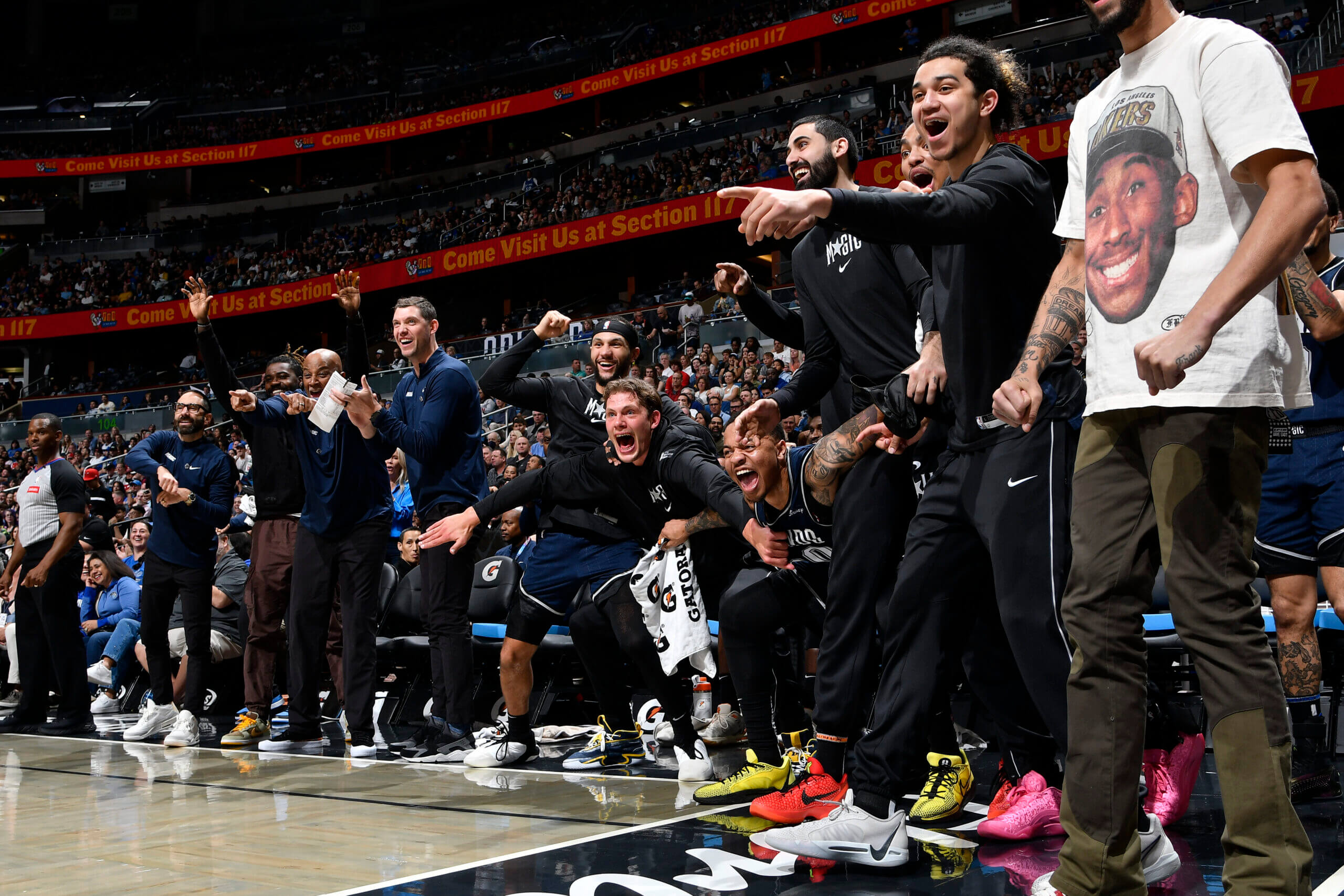
Scenes like this one, where Magic players and coaches rise from their seats on the bench to celebrate hustle plays, are common. (Fernando Medina / NBAE via Getty Images / Courtesy of the Orlando Magic)
Magic president of basketball operations Jeff Weltman and former general manager John Hammond hired Mosley in 2021, just a few months after they traded away veterans Nikola Vučević, Aaron Gordon and Evan Fournier to launch a fresh rebuild. The Magic went 22-60 in Mosley’s first season and 34-48 last season. But despite all those losses, Mosley and his assistant coaches fostered a “by committee” approach. Mosley had a large bell installed on a wall of the team’s practice court, and whenever players would make winning plays in practice — taking a charge, chasing down a loose ball, blocking a shot or passing the ball freely from side to side — someone would ring the bell. Little victories like that, plus a robust player-development program that emphasized individual improvement and team play, helped shape the team culture.
“I think that’s what this team is built on,” Mosley said, “knowing that everyone finds a way of being successful once they touch the floor because they’re giving to their teammates.”
True to his nature, Mosley, who was the runner-up in the 2023-24 NBA Coach of the Year voting, deferred credit to the front office, his assistant coaches, the player-development staff, medical staff and the players themselves.
But the players raved about Mosley’s contributions, calling him a players’ coach and master communicator who holds everyone accountable. “I think he brings a different type of coaching,” Fultz said. “He brings a sense of making sure we’re (doing what we’re supposed to do), but also makes sure we’re enjoying the moment.”
Most of the team’s players are in their early to mid-20s, which, as second-year swingman Caleb Houstan and Fultz said, helps them relate to each other. When the team is on road trips, it’s common for four or five guys to meet up in Fultz’s hotel room and play the NBA 2K24 and Madden NFL 24 video games against each other.
That togetherness transfers to the court.
“We all recognize that the more we succeed as a unit, the more everyone’s individual accolades will come to fruition,” Anthony said. “There’s a genuine love for each other.”
Last Monday, the players’ forlorn reactions after Suggs injured his left knee demonstrated the level of caring they feel for each other. That aspect of the story has a happy ending, though. Suggs avoided a major injury and played in the second half of the game. When Suggs was asked why he felt it was so important to return, he offered a concise answer.
“A little pain there, but the moment’s bigger than that,” Suggs said. “I was just trying to get out and get back to my brothers.”
(Top photo: Fernando Medina / NBAE via Getty Images / Courtesy of the Orlando Magic)