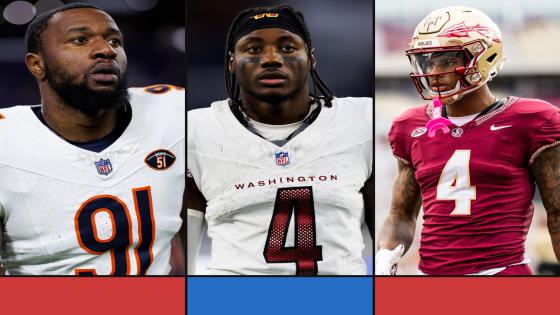
The NFL Draft has come and gone, and the Buffalo Bills officially have their class of 2024. The Bills opted on roster needs throughout the three-day event and came away with some starting options — for now and the future — and dependable depth to shore up things they didn’t have before the event began.
Now with a day to ponder what the Bills did, where do things go from here? What’s to come in their next stage of roster building before the season?
Here’s our post-draft Bills notebook.
What will the receivers look like?
Despite general manager Brandon Beane saying a week before the draft that he didn’t believe wide receiver was a “glaring hole,” the Bills used their top selection on Keon Coleman. The depth chart now has a fresh influx of young talent, something it desperately needed. So the big question is how does this look when the Bills arrive at spring practices in a few weeks?
*Undrafted rookies not included.
X-receiver: Keon Coleman, Mack Hollins, Justin Shorter, Tyrell Shavers
This is Coleman’s job to lose. He is, by far, the most talented player the Bills have at the position without ever taking an NFL snap. Even if he’s not an instant statistical star, his overall skill set with size, 50-50 catches and blocking will likely keep him on the field considering the drop-off behind him. Despite having a career year with the Las Vegas Raiders in 2022, Hollins hasn’t had another season in which he eclipsed 30 targets in his seven-year career. He also turns 31 in September. Shorter, a 2023 fifth-round pick, was on the Isaiah Hodgins rookie plan of being a Day 3 pick stored on injured reserve in his first season. His best chance to stick on the roster is on special teams and to try unseating Hollins as the backup X receiver. Beane mentioned Shavers as someone who has worked hard this offseason, though he has his work cut out for him if he wants to make the roster this year.

GO DEEPER
Bills draft Keon Coleman: How he fits, pick grade and scouting intel
Z-receiver: Curtis Samuel or Khalil Shakir, KJ Hamler, Quintez Cephus
Samuel could line up at Z-receiver more often than Shakir because Shakir played slot receiver and succeeded there last season, but the two are seemingly interchangeable. Hamler is an intriguing player who showed some promising things with the Denver Broncos, though he’s been unable to stay healthy throughout his career. The practice squad seems most likely for him unless he proves to be the vertical threat the Bills are looking for. Cephus likely has an uphill climb to make the team after being out of football for all of 2023.

GO DEEPER
Bills agree to 3-year deal with WR Curtis Samuel
Slot receiver: Shakir or Samuel, Andy Isabella, Bryan Thompson
Shakir and Samuel can play slot receiver, though Shakir’s success there late last year makes him the favorite to remain in that role to begin 2024. Isabella, one of last year’s top training camp stories, likely has an uphill battle to make the team again in 2024. Thompson was an undrafted free-agent rookie in 2023 and hung around on the practice squad all season.
If you’re looking for which spot the Bills could add to the position, finding a player who can play Z receiver or inside at slot receiver — or, better yet, both of those spots — would be the ideal way to round out the group, especially if it’s for a meaningful player they sign in free agency.
HOW DID HE NOT GO DOWN?!
What an effort by Khalil Shakir
📺: #PITvsBUF on CBS
📱: Stream on #NFLPlus https://t.co/rnjmj1Pg4j pic.twitter.com/M7bifWZrrK— NFL (@NFL) January 16, 2024
All eyes on June 1
With the Bills having completed the second building block of the NFL offseason, the 2024 team is mostly in place. But the Bills have an ace up their sleeves because a whopping $10.2 million of cap space opens when the Tre’Davious White post-June 1 release becomes official. The Bills would not have pushed dead cap into their 2025 ledger and delayed their potential cap space for 2024 without some plan of attack for what to do with it. Despite losing some key veterans, this season the Bills intend to reclaim the playoff success that has evaded them.
The likely goal was to reverse the events of their offseason, allowing the draft to dictate what they would do in free agency. Beane has long admired the NBA’s offseason schedule, which features the draft first, followed by the start of free agency a few days later after teams calibrate their needs for the coming season. Of course, the Bills did conduct some business when free agency opened in mid-March. However, the signings of Curtis Samuel and Austin Johnson, though helpful, weren’t the needle-moving acquisitions that will likely push the Bills into the Super Bowl. The $10.2 million that’s about to open will help with a possible signing or two.
Once the draft ends, it brings about another wave of free agency. Every year, a handful of notable players wait through the end of the draft to figure out the best place to go. It can also help boost their market because once the NFL is out of initial free agency and through the draft, options become limited at positions of need. So it benefits some of the players who wait and the Bills because any signing they make at that point will not count against their 2025 compensatory formula, which currently projects the Bills to get two more picks for the Gabe Davis and Leonard Floyd departures. The worst-case scenario is the Bills strike out on worthwhile free agents and roll all that additional cap space into 2025. But I believe the Bills will be in on conversations trying to add a veteran who can help immediately in 2024, possibly on a one-year deal.
Whom could they target?
Edge Yannick Ngakoue: If you had to ask me right now which position the Bills will go after on June 1, it would follow the same approach they had last spring. Leonard Floyd wound up as their most impactful free-agent addition in 2023, and without a pass rusher taken in the first four rounds, they have room to do that again. Ngakoue had only four sacks in 13 games with the Chicago Bears last season, but he had 10 in 2021 and 9 1/2 in 2022. He could be an impactful piece of the rotation and might even start.
WR Odell Beckham Jr.: The Bills were interested in acquiring Beckham two seasons ago when he was a free agent, but it never happened. He’s not the same player he was in his prime, but he would provide a name to the receiver group and some downfield ability the team doesn’t have in an established veteran. He’d push to start at Z receiver.
WR Tyler Boyd: Not as flashy a name as Beckham, but Boyd was an extremely dependable slot receiver for a long time for the Cincinnati Bengals. Especially with Shakir and Samuel capable of playing Z receiver, adding a cost-effective player like Boyd would make a lot of sense.
S Micah Hyde: Does he want to retire or play again? If he plays again, the Bills likely would welcome him back with open arms, and he wouldn’t cost too much.
S Justin Simmons: It depends on how ready the Bills believe Cole Bishop could be as a rookie and Taylor Rapp’s outlook as a starter, but Simmons instantly would be their top starting safety. He would cost a pretty penny, though.
To be determined: Several players the Bills could consider might not even be free agents yet. A handful of players usually becomes available after the draft once teams know who they were able to select and whether there is some roster duplication in some areas. Keep an eye out for potential wide receivers and edge rushers who move on from their current teams, as the Bills should and likely will give a lot of thought toward how to spend their $10.2 million after the amount for their draft class is accounted for.
Fifth-year option on Greg Rousseau is an easy call
The Bills haven’t made it official on Rousseau’s fifth-year option for 2025, due by May 2, but there is no mystery to the decision. The team is doing it with no hesitation. It’s not exactly a cheap price tag on Rousseau, whom Over the Cap projects to have a $13.387 million cap hit in 2025 with that fifth-year option. Some will argue Rousseau’s lack of counting stats is not worth that type of commitment. But when you put the last two years of his career into the proper context, not only is it an easy decision for the Bills, but it’s also the correct one.
In 2022, Rousseau looked like he was poised to break out in just his second season. He had five sacks in his first eight games and looked like a potential impact player, but a high ankle sprain derailed the rest of his year. He still wound up with eight sacks in 13 regular-season games. Last season, Rousseau appeared in 16 regular-season games but had only five total sacks, which seems like a step back for a player in his third season. But diving deeper into it shows that not only was he an impactful rusher, but he also made himself more valuable in the process.
Throughout his first two years, Rousseau essentially lined up only on the defensive left side against right tackles. It’s his natural position from college, so it came easier to him. But in 2023, out of team necessity, Rousseau became the primary starter at left defensive end, a major switch that shouldn’t be taken lightly. He lined up on the defensive right side on 54 percent of his edge snaps in 2023, but over his last seven games, playoffs included, Rousseau was on the right side on 69 percent of snaps. And even with that context, his pressure rate improved from an impressive 2022 season. Of the 376 qualifying defensive linemen over the last three individual seasons, Rousseau’s pressure rate by season ranked 33rd in 2022 (15.2 percent) and 24th in 2023 (15.8 percent), according to TruMedia and Pro Football Focus. Should the Bills return him to his most natural defensive left side, he could have a huge 2024 season, and the Bills should maintain his rights for 2025 because all the metrics indicate it’s coming at some point.
(Photos of Yannick Ngakoue, Curtis Samuel and Keon Coleman: Ryan Kang, Ric Tapia and James Gilbert / Getty Images)


