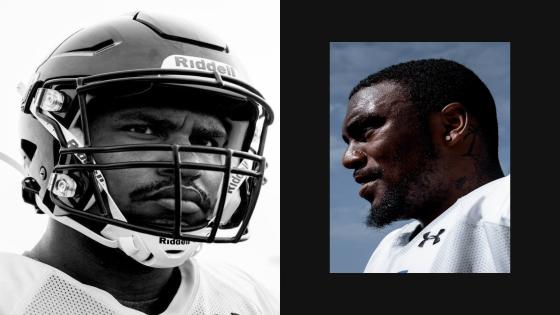
TAMPA — When Bayron Matos and Travis Clayton ran their 40-yard dashes, spectators whooped and clapped. Scouts in attendance shared knowing glances and compared stopwatches.
Two giant men, Matos (6-foot-7, 317 pounds) and Clayton (6-7, 301) clocked in times — 4.90 and 4.81 seconds, respectively — that would have made them the two fastest offensive linemen at this year’s NFL Scouting Combine. After the workout wrapped up, scouts flocked to the pair, forming large semi-circles around the 23-year-olds and peppering them with questions.
In the run-up to the 2024 NFL Draft, Clayton, from England, visited the Atlanta Falcons, Kansas City Chiefs, Baltimore Ravens, Cleveland Browns, and Pittsburgh Steelers and worked out for 10 more teams. Matos, from the Dominican Republic, visited the Cincinnati Bengals, who shared his medical information with other interested teams, and worked out for 12 more. Both players will be in Detroit on Saturday for Day 3 of the draft because league officials believe they will hear their names called before the end of the seventh and final round.
It’s impossible to discuss Matos or Clayton without referencing Philadelphia Eagles left tackle Jordan Mailata, the last player drafted out of the league’s International Player Pathway program. Since 2017, the IPP program has sought to provide players outside of North America with opportunities to play in the NFL, and IPP director James Cook said the interest in Matos and Clayton is the highest for any draftable player in the program’s history. Part of that interest stems from a sense of FOMO from teams that passed on Mailata, whom the Eagles selected with pick No. 233 in the seventh round in 2018 and has since developed into a left tackle worth signing to a three-year, $66 million contract extension earlier this month.
Cook said Indianapolis Colts general manager Chris Ballard mentioned Mailata during a conversation at last year’s combine. “The Colts were a couple of picks behind Philly, and (Ballard) said to me, ‘Yeah, I still kick myself that we didn’t jump ahead to get him,’” Cook said.
The Colts sent an offensive line coach to Florida to work out Matos last week. On the day he spoke to The Athletic, Matos had phone calls with five different NFL teams.
Now that Mailata has paved the way for an international offensive lineman with little to no football experience, there’s less hesitation to take a risk. “That’s basically the goal here, to find the next Jordan,” said one NFL scout who has evaluated both prospects. “It’s easier now to pull the trigger.”
NFL scouts use the word “project” to describe both Matos and Clayton. The same was said about Mailata, a rugby player who had never played football before being drafted. Clayton grew up playing soccer in England and picked up rugby in the last few years as he became serious about bulking up for the NFL. Matos moved to the U.S. to play basketball when he was 17 years old. He eventually made his way to the University of South Florida, where he tried out for the defensive line after being invited by the USF football coaches. It’s been widely reported that he never played in a college football game, but according to USF’s participation records, he actually did see the field for a few snaps on special teams and at defensive end during the 2022 season.
Scouts acknowledge that Matos and Clayton are both extremely raw, but the possibility of unearthing a franchise left tackle in the later rounds of the draft is tantalizing.
“Teams are really excited because he is a ball of clay, you can start from the ground up,” said Kyle Strongin, Clayton’s agent. “You look at guys in the middle rounds, and ask, ‘Can this guy play on Sunday?’ This guy can. You just have to get him there.”

Jordan Mailata has developed into a cornerstone left tackle in Philadelphia after being selected in the seventh round of the 2018 draft. (Eric Hartline / USA Today)
Former Falcons and Texans O-line coach Paul Dunn has coached the offensive linemen in the IPP program since 2018. He says Matos and Clayton are “much more athletic, much more advanced” than previous classes he’s coached and that both could hold more weight (Mailata weighed 345 pounds coming out).
Dunn was charged with introducing Mailata to football in 2018. He said the Australian was so fresh when he arrived that a simple bag drill that would normally take about 90 seconds to explain and run with American players took him about 35 minutes with Mailata and Christian Scotland-Williamson, another international prospect.
After they finished, Dunn let them get a drink. The two players poured Gatorade into their paper cups, then stood there for a couple minutes, not drinking. “I’m just trying to think, what’s the matter?” Dunn said. “They’ve been here doing this drill for 35 minutes, surely they have gotta be thirsty.”
Then Mailata and Scotland-Williamson tried to drink through their face masks, chinstraps still fastened. “It was like ‘Thelma and Louise,’ they kind of took the car over the cliff,” Dunn said.
From three fields over, current Seahawks defensive coordinator Aden Durde, then the IPP program director, yelled “Mates! Mates! That’s not how we do it!”
Dunn said Matos and Clayton were just as raw when they started with him in January. Clayton said he wasn’t familiar with every position in football. He knew the offensive linemen protected the quarterback, but that was about it.
“I kind of knew how many minutes are in a quarter and a half,” Clayton said. “But like, what 5-yard penalties are given for, what a 10-yard penalty is given for, I literally had no clue about anything.”
“Athletically, they can step out on the field right now,” Dunn said. “Where they’re going to be behind is in the classroom.”
Matos and Clayton practiced in helmets and pads for all ten weeks of the program. Dunn taught them everything they needed to know to be ready to practice with an NFL team, from how to hold a bag during a drill to how to block at the second level of a defense.
Coaches and scouts have spent the spring trying to figure out how much Matos and Clayton understand about the game. “Some teams would come and they think we are at level zero, like we don’t know about anything,” Matos said. “And then we knock them out.”
Clayton said at his visit with the Ravens, a coach schooled him on Baltimore’s pass protections, then erased the board and challenged him to explain it. “They were very impressed with my recall,” Clayton said. “I managed to put it back on the board in that quick-flip moment.”

GO DEEPER
Why Gaelic footballers have the NFL’s attention: ‘These lads can kick balls’
Not every team is equipped to draft a project prospect. Only recently successful teams with secure coaching staffs have the luxury of operating with the long runway required for their development. Even while learning under famed O-line coach Jeff Stoutland, who has been in Philadelphia since 2013, Mailata didn’t play for his first two seasons. Whichever team takes Matos or Clayton will have to have a plan to develop them.
Clayton said Steelers head coach Mike Tomlin presented him with a plan to play at defensive line first before they tried him at offensive line, and he said he even met with the Steelers defensive line coach Karl Dunbar. “It’s because of my speed,” Clayton said. Other teams have asked Clayton if he’d be open to playing another position, but none have had as detailed a plan as Pittsburgh.
In 2019, when Clayton was 17, he tried out for the brand-new NFL Academy in London. He went through all the combine drills and was set to move on to the next phase of the program, which combines education and football training to prepare young international players for college football scholarships. But he decided to quit, and that decision haunted him for several years.
“I didn’t really take the opportunity with two hands,” he said. “I felt as if I’d let my family down and my friends down at that time.”
After taking a year off from playing sports of any kind, Clayton realized how much he missed competition. So he joined his local rugby club, practicing twice a week and playing games on the weekends “to put his body to good use.” At the start of 2023, he still couldn’t shake his regret about leaving the NFL Academy, so he reached back out. Cook was happy to welcome him back into the fold, this time in the IPP.
Matos spent last year playing professional basketball in Venezuela. But, like Clayton, he couldn’t stop thinking about the small taste of football he’d had at USF. Matos returned to the U.S. last July and did a private workout for the IPP in Miami this fall. Cook said he already knew about Matos through an NFL game of telephone: a trainer who’d worked with Matos told a friend who works for the Rams, and that friend told Cook he probably should know about this “huge Dominican basketball player.”
Back in 2018, the IPP was in its second year, and the program was barely credible. Five years later, scouts treat the IPP like another school call, and teams assign the program to an area scout. “In the earlier years, you were trying to get teams bought in and interested,” said Cook. “(This year) I had teams reach out to me before we even got to our camp in Florida, saying, ‘Who have you got this year?’ They have us in mind from the beginning.”
Each NFL team is permitted to host 30 draft prospects at their facilities ahead of the draft, and Clayton was shocked when he started getting invitations. “For me to just be playing this game since January and for teams to want me to have one of 30 visits, it shows that they’re very much interested,” he said. “And it shows that all the hard work that I’ve put in since January has paid off.”
Matos’ older brother and cousin are joining him in Detroit on Saturday. His mom will be watching from the Dominican Republic. Clayton’s mom and his sister’s boyfriend will be flying in from England to support him. He bought a black suit and gold chain and gold watch to wear.
Both Matos and Clayton consider Mailata a role model and inspiration. They mention him when they talk to teams and had the chance to pick Mailata’s brain when he visited the IPP players in January. “It took him two years to step on the field,” Matos said. “Stay patient and stay ready to go, keep working and be the first one in and last one out.”
Dunn said he’d be shocked if the two aren’t drafted. The level of interest from teams ahead of the draft could make signing them as undrafted free agents a nightmarish frenzy, and teams would risk losing them to competition. Another thing going for Matos and Clayton: This year, for the first time, each team is allotted an extra 17th practice squad roster spot specifically for an international player.
If both get drafted, it’ll be history for the IPP, which has never seen more than one prospect drafted in the same class. (The majority of IPP prospects are far enough removed from high school that they are free agents instead of draft-eligible prospects.)
“You don’t see athleticism and want-to like these two men have right here,” Dunn said. “They just don’t fall off trees like this. The teams that are patient with them, just like the Eagles were patient with Jordan, are going to be very pleased. Give them a little time. The end product is going to be well worth the wait.”
(Photos of Clayton and Matos courtesy of NFL)


