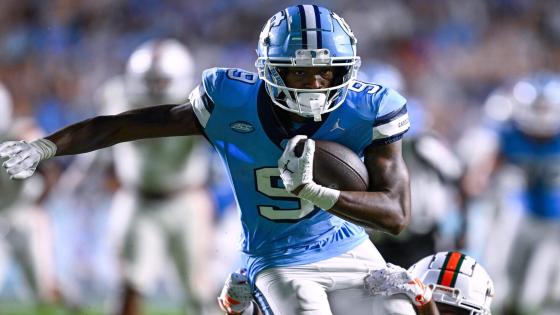
The Baltimore Ravens entered the 2024 NFL Draft Thursday night with nine picks over the three-day event.
With their first pick, at No. 30 overall, the Ravens bolstered their secondary by selecting Nate Wiggins, a cornerback from Clemson. Wiggins was a two-year starter at Clemson, playing primarily as an outside cornerback for the Tigers. He allowed a 43.9 completion rate when targeted in 2023, and two of his three career interceptions came against Drake Maye, the No. 3 pick in the draft.
Baltimore addressed its offensive line in the second round, taking Washington tackle Roger Rosengarten with the 62nd overall pick. After practicing as a left tackle his first two years on campus, he moved to the right side before the 2022 season when Michael Penix Jr. transferred to UW so he could protect the left-handed quarterback’s blindside.
The Ravens went back to defense in the third round, selecting edge rusher Adisa Isaac out of Penn State with the No. 93 overall pick.
They started Day 3 on the offense, grabbing North Carolina receiver Tez Walker with pick No. 113, and then added their second cornerback in the draft by taking T.J. Tampa from Iowa State with pick No. 130.

GO DEEPER
Ravens free-agency tracker: Kyle Van Noy returns, Jadeveon Clowney heads to Panthers
Keep coming back here throughout the draft for analysis and grades for each Ravens pick.
Round 1
No. 30: Nate Wiggins, CB, Clemson
Dane Brugler’s analysis
Wiggins moves with quiet, controlled feet/hips to seamlessly transition out of breaks and accelerate to top gear (allowed only one catch of 20-plus yards on 41 targets in 2023). Though he needs to improve his consistency as a run defender, he shows tremendous effort in pursuit and had two chase-down forced fumbles that saved touchdowns in 2023 (Miami and North Carolina).
Overall, Wiggins’ slight frame and suspect play strength are legitimate concerns, but he is a fast and fluid athlete with the cover awareness and on-ball production to be a starting perimeter corner in the NFL. He projects as a longtime NFL starter with tools like those of Dominique Rodgers-Cromartie.
Nick Baumgardner’s grade: A-
One of the fastest players on the board (4.28 at the combine), Wiggins is fast off the line of scrimmage and also possesses excellent second-level speed — making him incredibly difficult to beat vertically. Wiggins’ length at 6 feet 1 with near-31-inch arms is also a plus, as he got his hands on 25 passes over the last two seasons at Clemson.
The question marks here are size and power. Wiggins was 173 pounds at the NFL Scouting Combine before reporting a 182-pound weight later at his pro day. He was mainly an outside-only corner in college, and there are questions about how much he can give a team against the run. A first-round talent in this draft, though, to be sure.
Round 1 grades for all 32 picks
Jeff Zrebiec’s analysis: How does Wiggins fit with the Ravens?
Round 2
No. 62: Roger Rosengarten, OT, Washington
Dane Brugler’s analysis
In both the run game and pass protection, Rosengarten explodes out of his stance with enough quickness to find the correct angles and work his hands into correct position. However, he needs to play with better timing to compensate for his average core strength and inconsistent bend — or things unravel quickly (see his tape against Michigan in his final game in the 2023 national championship game).
Overall, Rosengarten’s pass protection won’t win any beauty pageants, but his feet stay active, and he trusts his handwork and eyes to execute his blocks. He projects as an immediate swing tackle for an offense with the potential to be a dependable starter if he continues to develop (stylistically similar to Garrett Bolles).
Nick Baumgardner’s grade: B+
An outstanding athlete who played opposite Troy Fautanu for the Huskies, Rosengarten is more of a traits project right now than a finished product — but his speed and footwork on the edge make him an intriguing prospect who could be a left or right tackle in the NFL. He needs to get stronger and become more consistent with his technique in general, but this is a versatile piece in an area where Baltimore has to get better.
Jeff Zrebiec’s analysis: How does Rosengarten fit with the Ravens?
Round 3
No. 93: Adisa Isaac, edge, Penn State
Dane Brugler’s analysis
A two-year starter at Penn State, Isaac lined up as an edge rusher (two- and three-point stances) in former defensive coordinator Manny Diaz’s 4-3 base scheme. His tape and production improved each season in State College and culminated with him leading the Nittany Lions in both tackles for loss (16) and sacks (7.5) as a senior (accounted for 27.0 tackles for loss over 26 games the last two seasons). With his package of traits, Isaac’s athletic twitch as a pass rusher and promising point-of-attack skills in the run game stand out on tape. However, his inefficiency at contact and freelancing tendencies are a few of several areas that remain a work in progress with his game.
Scott Dochterman’s grade: A+
Once again, Baltimore comes away with a productive, high-value pick. Playing on the opposite side of teammate Chop Robinson, Isaac led Penn State with 7.5 sacks and 16 tackles for loss last year. A team captain, Isaac (6-4, 247) was a defensive leader for the Nittany Lions and he was well-rounded as a pass rusher and run defender. Blessed with long arms (33 ⅞ inches), Isaac often doesn’t allow tackles to get their hands on him in pass-rush situations. This is value meeting need.
Round 4
No. 113 (via Jets): Devontez Walker, WR, North Carolina
Dane Brugler’s analysis
A one-year starter at North Carolina, Walker was an outside receiver in offensive coordinator Chip Lindsey’s scheme, lining up almost exclusively to the right of the formation. His fight for eligibility last season received national attention, and his impact on the Tar Heels’ offense was obvious once he took the field.
With a high average depth of target in 2023 (18.2 yards), Walker did his best work downfield using his acceleration, tracking skills and ability to change gears when the ball was in the air. However, he won’t get easy looks in the NFL, and his route running is begging for improved footwork, tempo and overall deception to help him uncover on intermediate routes.
Overall, Walker is a vertical/stretch receiver who requires a linear route tree, but he is a big-play threat with a promising catch radius and the speed to climb on top of coverage. He must develop better consistency in his routes and hands to be more than a complementary outside option.
Jeff Zrebiec’s analysis
Walker diversifies what has been a small Ravens wide receiver corps. He’s 6 feet 1, 193 pounds and runs a 4.36 40. Ravens first-round pick Nate Wiggins allowed one 20-plus yard completion last season. It was to Walker.
No. 130: T.J. Tampe, CB, Iowa State
Dane Brugler’s analysis
Tampa has the ingredients to be a pressman corner, but he did his best work on tape from off-coverage, where he accurately saw through receivers to the quarterback and overlapped zones to drive on throws. Despite having only three interceptions on his college resume, he plays the ball well, with the timing to attack the catch point simultaneously with receivers.
Overall, Tampa gets a little sticky with his footwork at the top of routes, but he doesn’t lose much separation and plays with the size, range and ball skills to be disruptive. He has the tools and potential to be a starting perimeter cornerback in various schemes.
Jeff Zrebiec’s analysis
Brugler had Tampa as the eighth-best corner in the draft and ranked 49th overall player. He’s 6-foot, 194 pounds, and he had 24 career pass breakups. With the addition of Wiggins and Tampa, the Ravens have upgraded their cornerback depth in a big way.
Round 5
No. 165
Round 6
No. 218 (via Jets)
Round 7
No. 228 (via Jets)
No. 250
(Photo of Devontez Walker: Grant Halverson / Getty Images)