The 2024 NFL Draft is just days away, and the Buffalo Bills hold the 28th overall pick. But as always, you never quite know what Bills general manager Brandon Beane will do. We’ve got plenty to discuss, so let’s gets straight to it with a draft week staple.
Part 1 of The Draft Files, an annual unpacking of my notebook and draft brain about the Bills’ potential draft strategy, combining what the Bills have said, the team’s actions, positional values, recent trends, roster and cap structuring and an absurd amount of time by yours truly considering every possible scenario.
1. Understanding where the Bills build is and how it impacts the draft
This offseason saw the biggest roster shakeup since 2019 when the Bills started to build up around then-second-year quarterback Josh Allen. There are only 33 players who were either on the 53-man roster to end the year in 2023 or on in-season injured reserve that remain with the team for 2024. With so much turnover, there will be a natural evolution in how they do some things.
They might be slightly returning to the early Sean McDermott and Beane build. Back then, they didn’t have as many permanent players for their starting lineup and allowed the opportunity for depth chart mobility. That has not been as prevalent since 2020. Because they had found answers at most positions, chances to start — or even get playing time — were tough to come by for younger players. Those opportunities are slowly opening again. And because of that, it makes for some glaring draft needs, just as the Bills had in their first three drafts under Beane — 2018 through 2020.
Each time there was a clear need during those three years, Beane addressed them early. In 2018, the Bills needed a quarterback and a middle linebacker badly. Enter Josh Allen and Tremaine Edmunds. In 2019, they sorely lacked a three-technique defensive tackle to build around, as well as a right tackle. Ed Oliver and Cody Ford, welcome to the program. In 2020, the Bills needed a wide receiver to top the depth chart and a defensive end to help change the dynamic of their pass rush. Beane traded for Stefon Diggs and drafted A.J. Epenesa. Some worked, and some didn’t, but the “best player available” strategy hasn’t usually been their lean with their top selections. For them, it’s all about a term I’ve used for several years: “need meets value.” And it’s why we should begin where we all think we should.
2. The WR need and Beane doing his best to sidestep it last week
The notion of adding a wide receiver has always been top of mind, even before trading away Stefon Diggs earlier this month, as it began with starter Gabe Davis leaving in free agency. The Diggs trade only gave further fuel as to why it’s the odds-on favorite to be their first-round pick this year. As of now, their top three receivers ring slightly hollow. Khalil Shakir came into his own in 2023, but likely isn’t anything more than a No. 2 or No. 3 target in an offense. Curtis Samuel had success with Bills offensive coordinator Joe Brady in Carolina in 2020, but that was the only year out of seven that he eclipsed at least 700 yards. Mack Hollins has only been targeted more than 30 times in a year in one of his seven NFL seasons and also turns 31 in September.
Even with those optics, and having the most unproven overall group of receivers they’ve had since 2018, Beane did what he could to slow down the public pressure to draft a receiver in his pre-draft press conference.
The highlights:
“We have not filled a number one role. I would say we have a group of guys as we sit here today, that we believe bring different skill sets. We like the group. You know, would we like to add to it at some point? Yes. But, I’m not sitting here thinking we have a glaring hole. But I get the question. I get the perception.”
“I don’t think having a one or not having a one doesn’t mean we can’t have success, you know, on offense or as a team.”
“Now that Josh is ascended to the player he is, is [having a No. 1 WR] a requirement? I don’t think so.”
Reading all that, you would think the Bills have convinced themselves that their wide receiver room doesn’t need a grandiose addition. I found it interesting to return to this same press conference only two years ago.
3. Looking back to 2022, why it’s relevant and what it means
Just two years ago, the Bills were in a similar spot where the writing appeared to be on the wall for their top pick. At cornerback, 2021 starter Levi Wallace left the team via free agency, and their top cornerback Tre’Davious White suffered a torn ACL late in the season. As we know now, White returned late into 2022 and wasn’t the same player until the beginning of 2023. It’s as close a case as this offseason and being without both Diggs and Davis. And they even had a Shakir type, in the form of then-third-year player Dane Jackson. In that pre-draft press conference, the questions about cornerback came early. Some of the highlights from Beane in 2022:
“We don’t feel like, ‘We’ve got to get this, or we’ve got to get that.’”
“I get the question. I’m not saying you’re out of line, but I’ve got a lot of confidence in Dane and the guys here too. I mean, he’s played for us two years in a row and I’m a fan. I think he’s done a really good job. And I think again, how we build this thing as well, we build it up front. And so, part of that is, you know, if you’re strong up front, you can help your back end.”
He emphasized they liked what they already had on the team. He also discussed a notion of why finding that specific position may be a little devalued to them. In this case, that involved their focus on the defensive line.
For receivers, a similar approach was used last week. First, they discussed that they liked their room, and then, when asked about the topic of a No. 1 receiver, they said you don’t need to have one to be a successful offense. But all of that can be true. It doesn’t rule out them looking to find a new No. 1 or even someone who can be their top target, even if not an unquestioned No. 1 receiver.
As we well know, the Bills not only drafted a cornerback in 2022 but moved up to get one in the first round. Shortly after the pick, Beane pulled back the curtain a bit.
“Obviously, I’ve been hearing it loud and clear — ‘We don’t have a corner’ — from every single one of you, neighbors, kids, everyone,” Beane said after drafting Kaiir Elam. “So we’ll all sleep good tonight that we added a corner.”
And they drafted another cornerback in the sixth round that year, too, by the way (Christian Benford).
4. Trading up, and, despite what Beane said about the WR need, is completely in play
By now, you probably understand what Beane is all about. He has a history of trading up. He did it for Josh Allen, Tremaine Edmunds, Cody Ford, Dawson Knox, Zack Moss, Kaiir Elam, Khalil Shakir and Dalton Kincaid. That’s eight times in six drafts, four in the first round. To his credit, he actually has traded down during one draft, doing so twice in the 2022 second round before taking James Cook.
Beane said he had a trade to move down last year and would have done it if he couldn’t get Kincaid — but he didn’t. Despite giving us the information, he doesn’t get credit for doing the move, because ultimately, he did what he has always done in the first round. He chased after a player who excited him, just as he always said he’s open to doing.
“Right or wrong, I probably deserve criticism for trading up sometimes. I get that,” Beane said last week. “But if there’s a guy I like and I’m confident, I want to go to bed Thursday night [knowing] that I got him.”
Another nice little highlight from the 2022 pre-draft press conference is when Beane said, “I’m my own worst enemy with patience.”
One of his biggest reasonings in the past for moving up has been to select a first-round player who has a first-round grade. While holding the No. 28 pick, in this year’s class, the GM wasn’t shy about how many first-round grades they’ve given out this year.
“Not 28,” Beane said.
At the very least, the table is set for them to try to get aggressive. This year, Beane is armed with eight Day 3 picks, more than they’ve had in multiple drafts, but only one pick in the first and one in the second. To make any legitimate move up the board, they likely need to dip into either their 2025 first or one of their two second-round selections next year. Trading next year’s first-round pick is likely one of the biggest internal dilemmas Beane will have.
“I’m never going to say no. I don’t love trading future ones,” Beane said when asked, even discussing how they were at times forlorn over a deal in Carolina the following draft after sending away a future first.
But after all that, Beane finished the answer leaving the door wide open.
“But listen, we did it for Stefon Diggs when we traded for him and sat through that [draft],” Beane said. “If there’s something that makes too much sense… heck yeah.”
The ‘very likely not going to happen’ tier: Marvin Harrison Jr., Ohio State
As much chatter as there’s been about some teams preferring Malik Nabers over Harrison Jr., it just seems very likely that Harrison Jr. will be off the board either at No. 4 or No. 5.
The ‘it would likely take your 2025 1st to get him’ tier: Malik Nabers, LSU and Rome Odunze, Washington
In a normal draft class, both players would be the clear No. 1 receiver on the board. For there to be three guys like that this year is pretty wild.
The ‘it would likely take your 2025 2nd to get him’ tier: Brian Thomas Jr., LSU
There is a drop-off from the top three to Thomas Jr., but his blend of size and skills, plus the potential he has to turn into a No. 1 in the NFL, has him in his own tier, in my opinion. Our draft expert, Dane Brugler, has a clear drop-off as well, with the receivers ranked after Thomas Jr. having, at best, a fringe first-round draft range.
The ‘maybe it’s best to stay at No. 28 and see what happens’ tier: Everyone else
Some may argue that Adonai Mitchell should be closer to the Thomas Jr. tier, but some concerns about his prospect profile may push him closer to the rest of the pack at receiver. The Bills could be forcing it a bit if they move up for anyone outside the top four wideouts.
6. How much to move up? Pick-by-pick breakdown
Because Beane is so trade-forward, one of the things I like doing every year is providing the potential cost to move up to each selection. There isn’t one universal trade value chart throughout the league, which is why I use the Rich Hill trade value chart, which bakes recent trades into the values of individual selections.
So let’s take a look at the cost of moving up, by pick, beginning at No. 4.
Bills potential costs for trading up
| Pick No. | Team | Value | Note | Bills Assets | Round 1 | Round 1 | Round 2 | Round 2 | Round 3 | Round 4 | Round 4 | Round 5 | Round 5 | Round 5 | Round 6 | Round 6 | Round 7 |
|---|---|---|---|---|---|---|---|---|---|---|---|---|---|---|---|---|---|
Bills Return Value | No. 28 | 2025 | No. 60 | 2025 | 2025 | No. 128 | No. 133 | No. 144 | No. 160 | No. 163 | No. 200 | No. 204 | No. 248 | ||||
4 | 491 | 493 | 209 | 121 | 88 | 56 | 19 | ||||||||||
5 | 468 | 474 | 209 | 121 | 88 | 56 | |||||||||||
6 | 446 | 447 | 209 | 121 | 88 | 19 | 10 | ||||||||||
7 | 426 | 428 | 209 | 121 | 88 | 10 | |||||||||||
8 | 406 | Nos. 79, 197 to BUF | 464 | 209 | 121 | 88 | 19 | 17 | 10 | ||||||||
9 | 387 | No. 75 to BUF | 450 | 209 | 121 | 88 | 19 | 13 | |||||||||
10 | 369 | No. 72 to BUF | 437 | 209 | 121 | 88 | 19 | ||||||||||
11 | 358 | 358 | 209 | 88 | 56 | 5 | |||||||||||
12 | 347 | No. 147 to BUF | 363 | 209 | 88 | 56 | 10 | ||||||||||
13 | 336 | No. 112 to BUF | 363 | 209 | 88 | 56 | 10 | ||||||||||
14 | 325 | 326 | 209 | 88 | 19 | 10 | |||||||||||
15 | 315 | No. 82 to BUF | 370 | 209 | 88 | 56 | 17 | ||||||||||
16 | 305 | No. 81 to BUF | 367 | 209 | 88 | 56 | 10 | 4 | |||||||||
17 | 296 | 297 | 209 | 56 | 19 | 13 | |||||||||||
18 | 287 | 288 | 209 | 56 | 19 | 4 | |||||||||||
19 | 278 | 278 | 209 | 56 | 13 | ||||||||||||
20 | 269 | 269 | 209 | 56 | 4 | ||||||||||||
21 | 261 | 263 | 209 | 25 | 19 | 10 | |||||||||||
22 | 253 | 255 | 209 | 19 | 17 | 10 | |||||||||||
23 | 245 | 245 | 209 | 19 | 17 | ||||||||||||
24 | 237 | 238 | 209 | 19 | 10 | ||||||||||||
25 | 230 | 232 | 209 | 19 | 4 | ||||||||||||
26 | 223 | 222 | 209 | 13 | |||||||||||||
27 | 216 | No. 226 to BUF | 219 | 209 | 10 |
7. Scouting the teams in front of the Bills and where to strike
Studying the opponents’ needs is one of the most important aspects of any trade-up. Using our excellent band of beat reporters here at The Athletic, here is a look at the top needs of every team from No. 4 through the Bills pick at No. 28.
Team by team draft needs: Picks 4 to 28
| Pick No. | Team | |||||
|---|---|---|---|---|---|---|
4 | WR | EDGE | CB | |||
5 | WR | CB | OL | DT | RB | |
6 | QB | WR | CB | RB | DT | |
7 | LT | RT | EDGE | ILB | ||
8 | EDGE | CB | WR | |||
9 | QB | EDGE | DT | OT | WR/TE | |
10 | WR | OT | RB | S | QB | |
11 | QB | DT | CB | |||
12 | QB | TE | CB | EDGE | ||
13 | QB | CB | OT | IOL | ||
14 | OT | EDGE | WR | |||
15 | CB | WR | EDGE | |||
16 | G | LB | S | DT | TE | |
17 | CB | OL | WR | DL | ||
18 | DT | WR | OT | |||
19 | EDGE | DT | RB | WR | CB | |
20 | C | WR | OT | DT | DB | |
21 | G | EDGE | DT | WR | S | |
22 | CB | LB | OT | G | WR | |
23 | QB | DT | CB | |||
24 | RB | IOL | OT | DT | LB | |
25 | S | ILB | OT | |||
26 | OLB | C | G | EDGE | ||
27 | WR | EDGE | CB | |||
28 | WR | S | EDGE | DT | IOL |
Ok, so we’ve got the potential costs, and we’ve got who needs what and what could facilitate a move up the board. Two specific ranges stand out for both what is realistic for the Bills to give up and motivation to move to those spots.
8. The Nabers and Odunze trade-up sweet spot: No. 8 or No. 9
The New York Giants are a threat to take a receiver which is emphasis for a move up there, but the cost to move up to the Giants’ pick at No. 6 might be a bit much for Beane to stomach. Past them, the Titans at No. 7 just signed Calvin Ridley to a long-term deal and have a major need at offensive tackle. The Falcons at No. 8 have big talents in Drake London, tight end Kyle Pitts and signed receiver Darnell Mooney to a lucrative deal this offseason. They could take one but don’t seem like big threats to do so.
The goal would be to get ahead of the Chicago Bears at No. 9, who could use another wide receiver, or to move into the Bears’ spot at No. 9 to stay ahead of the potentially wide receiver-hungry New York Jets. That sort of trade package should especially speak to the Bears since they only have four picks total in this draft, just had a ton of success trading a pick for a future 1st last year, and likely aren’t aiming for immediate playoff success in Caleb Williams’ first season. It’s a very good haul for moving down only 19 spots.
At No. 8 or No. 9, the Bills would get back a mid-3rd to include No. 60, which isn’t a backbreaking drop-off. The best case scenario, if the Bills wanted to move up this far, is to do business with the Bears at No. 9 and potentially still have Nos. 75, 133, 160, 163, 200, 204 and 248 for the rest of their class.

GO DEEPER
Bills NFL Draft 2024 guide: Picks, predictions and key needs
9. Is Nabers or Odunze worth the hype?
Yes. Yes they are. It all depends on what you want as the two are different types of receivers. But for the Bills, either of those players works in their offense. Nabers isn’t quite as big (6-foot, 200 pounds), but the way he separates from defenders is outstanding, and his ability to run after the catch (RAC) truly has game-breaking potential. The Bills have talked about wanting players who bring more RAC for years and haven’t been able to break through from that perspective. Nabers would bring that, along with having the versatility to play at X, Z or at slot receiver.
Odunze is a more prototypical X-receiver who is versatile enough to move around the offense a bit. He can separate and get some yards after the catch, though not quite the game breaker of Nabers. But Odunze beats Nabers in having the slight advantage in size (6-foot-3, 212 pounds), contested catch ability and the body control to come down with plenty of sideline chances. Both players have a pretty realistic case to become a team’s No. 1 wide receiver.
Ultimately, if the Bills want to move up for one, it probably won’t be up to them to pick between these two. It only matters if they deem it worthy to trade a 2025 first-round pick for the player potentially on the board late in the top 10.
10. The Thomas Jr. trade-up sweet spot: Nos. 13, 15, 16 or 17
The optimal goal in a trade-up to acquire Thomas Jr. would first be to avoid dealing their 2025 first-round pick. After that, it’s either to get a third or early fourth back for including No. 60, or to not include No. 60 at all. The earliest that’s realistic is with the Las Vegas Raiders at pick No. 13. If the Raiders are as enthusiastic about taking quarterback Michael Penix Jr. as the whispers indicate, it could make sense for them to do a trade down, collect value, and then do a mini-trade up from No. 28 to get their guy. The New Orleans Saints at No. 14 don’t have a third or fourth-round pick, so they don’t seem as strong of potential trade partners for the Bills.
It gets really interesting at No. 15 with the Indianapolis Colts. They have been known to trade down for a good deal, and the Bills could move No. 60 and get No. 82 back to keep them in the game on Day 2. The same goes with the Seattle Seahawks at No. 16, and the Bills would have only have to give up an additional fifth rather than a fourth. Those two picks might be the ultimate sweet spot, as both the Jacksonville Jaguars and Cincinnati Bengals look to be risks to take a wide receiver. They could also both be trade partners. Beginning at No. 17, that’s where No. 60 doesn’t need to get included. If Beane wants to play the draft game a bit and wait until that spot, keep an eye on the Jaguars for a possible deal, just like it happened between the two teams last year. That might be the latest they can afford to wait to move up for Thomas Jr.. Any later than that, and the cost just keeps going down, though it’s unlikely Thomas Jr. is still there.
11. Why Thomas Jr. seems to check every box
You could tell last week that Beane was conflicted about trading their 2025 first-round pick. Trying to move up that far also comes with the risk that teams may not want to move down to the late first round, regardless of what they’re getting back. It becomes a bit easier to do near the middle of the round, and the Bills also wouldn’t have to deal their top pick in 2025. It’s all part of why a move up for Thomas Jr. stands out.
Outside of that logic, his game is a perfect fit for what they’re likely looking for in a receiver to draft. Plenty of prospects available later would duplicate what the Bills already have in house with Shakir and Samuel. Thomas Jr. is not that. He has outstanding size at almost 6-foot-3 and 209 pounds, he has elite speed for that size that shows up on film and is a big play waiting to happen. He’s got loads of experience as an X-receiver and can also play at Z. He can stick his foot in the ground and, with his acceleration, separate from the defender. He can win contested catches, though not as well as Odunze. Although not at the same level as Nabers, he has good RAC potential and has the physicality to get through tackles for some extra yards. The trouble is, he’s got limited production comparatively and is more of a raw route runner than the top three. That’s where the boom-bust profile and downgrade in cost comes in.
To me, when scouting traits at certain positions, there are two different categories. There is a “need-to-have” category and an “nice-to-have” category. For the Bills this year — only in a move up — the need-to-have traits are likely separation, size, speed, RAC and the ability to deal with the physicality of the X-receiver position. The nice-to-have traits are route running, which the Bills helped Gabe Davis through not long ago, and blocking, which Thomas Jr. has at least shown to be a willing, yet inconsistent blocker.
It all checks out. Beane has the reputation of swinging for the fences in the first round, and Thomas Jr. fits that mold of a potential No. 1 wideout with some projection at a slight discount. So if he’s still on the board beginning at No. 13, keep an eye out for the Bills. He makes way too much sense for what they need this year.
Coming up in Part 2 on Tuesday: The Adonai Mitchell conversation, names to monitor for No. 28 by position, the idea of trading down, strategy at No. 60 and much more.
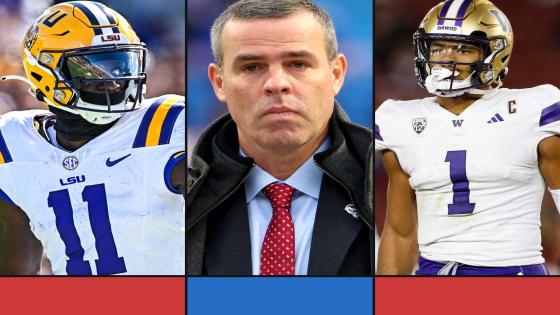
(Photos of Brian Thomas Jr., Brandon Beane and Rome Odunze: Rick Ulreich, Timothy T Ludwig and Brandon Sloter / Getty Images)