
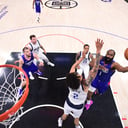
LOS ANGELES — With just under nine minutes remaining in Game 1 against the LA Clippers, Luka Dončić floated back to his defensive spot in the left corner and glanced back, away from the game being played around him, at a video board mounted in the rafters that showed the score. Having verified his team still trailed the L.A. Clippers by 19 points, his shoulders slumped ever so slightly. This rematch, after a three-year wait, was ending in disappointment, at least temporarily, yet again.
The Dallas Mavericks lost Game 1, a 109-97 drubbing never really in doubt even as Dallas chipped away at the Clippers’ 26-point halftime lead during the final 24 minutes. Asked about the slow start, which included just eight points in the second quarter and two in the frame’s final seven minutes, Dončić said, “I don’t know why it happened.”
Dallas had won 16 of 18 games to close the regular season before resting stars in the regular season’s last two contests. Prior to the game, they received news that Clippers star Kawhi Leonard would be absent. And while the second quarter could be blamed for the defeat — Dallas lost it by 14 in a game that finished with a 12-point margin — the Mavericks weren’t ready from the opening tip, either.
“Our first half, our offense, we got stuck there in that second quarter,” Dallas coach Jason Kidd said. “I liked the way that we played there in the second half. We got to build on that.”
After the game, Dallas stuck to one consistent message: It wasn’t ready for the Clippers’ physicality.
“We expected them to come out and be physical, but we didn’t respond to their physicality,” Kidd said.
Center Daniel Gafford agreed, saying, “It’s just a level of physicality (that) forced us to do things that they wanted us to do.” And Dončić said the improved second half was due to the team being “more physical on defense, that’s about it.”
GO DEEPER
Clippers pledged to be ready for Game 1 without Kawhi Leonard — then proved it
Dallas’ winning formula during its post-trade-deadline surge came from the team’s newfound physicality and size. The Mavericks acquired Gafford and wing P.J. Washington, both of whom quickly turned into starters. The moves led to Dallas having the league’s best defense since the acquisitions, buoyed by allowing the league’s sixth-fewest shots at the rim and third-lowest percentage. With Gafford joining rookie Dereck Lively II, the center position became both a strength and a constant. Dallas was a team that dominated inside on both ends.
And yet Dallas was outscored 24-8 in the paint in Sunday’s first half. Clippers center Ivica Zubac, a matchup liability in these teams’ previous two playoff series in 2020 and 2021, featured early in this game, successfully posting up Gafford several times and finishing the game with 20 points and 15 rebounds. It was dire enough that Kidd closed the half with Maxi Kleber, the team’s less physical big, but one who shoots 3s.
“I just didn’t come out to play, honestly,” Gafford said at his locker after the game. “I have to be better (as) a starter.”
In 2022, when Dallas made its unexpected run to the conference finals in Kidd’s first season as coach, the team lost Game 1 every series. The adage is that postseason basketball is as strategic as chess, a contest of adjustments that happen as the regular season’s randomness falls away and adjusting to the familiarity of the opponent takes its place.
The Mavericks’ adjustments came faster after halftime. Kidd tried more five-out lineups with Kleber. He gave nine minutes to Josh Green, a bench guard who hadn’t been in the rotation plans. Kidd tasked Dončić as the primary James Harden defender at times and even had Lively switch onto Harden twice in the fourth quarter, a pick-and-roll coverage the team has rarely used with either traditional center. What Dallas did in the game’s second chapter looked far different than its disastrous first, and Dallas outscored the Clippers by 14 to at least make the final score more respectable.
Of course, there’s no strategic adjustment better than the classic one from dads everywhere: Just play better, son. Kyrie Irving was the one Maverick who strayed slightly off script. While he mentioned physicality, Irving’s point was less about how the Clippers used it and more about the team’s control over their own.
“I don’t think that we came out very flat or without energy,” he said. “I just think that our mind was all over the place. It’s our first playoff game together, we got to settle in.”
“You can see that we were starting to look like the Dallas Mavericks we know ourselves to be,” he added. “So it’s the first game of a long series and excited to see what happens Game 2.”
If Dončić couldn’t explain the team’s slow start, there’s not much hope an outside observer can do it any better. But for his part, Dončić was dreadfully below his lofty standards in the first half, scoring 11 points on 4-of-13 shooting. Although Lively and especially Gafford failed to make an impact, both centers serve as an extension of the superstars this team relies upon. When Dončić and Irving hum, Lively and Gafford often profit from it.
Irving contributed 20 points in the third quarter on perfect shooting (8-of-8), the first such quarter in the entire history of the NBA’s postseason. The box score shows that he and Dončić contributed 21 made field goals to the rest of the team’s 10.
But no matter how different this new iteration of the Mavericks has looked this season — not always relying on making 3s, not dependent on its role players’ scoring — its winning formula harmonizes with its superstars’ shotmaking and their ability to “touch the paint,” as Kidd calls it. Neither of those things were present enough in the first half Sunday, and that may have had a tonal effect on the players around them. The Mavericks’ “others” rarely faced the scrambling defenses they were accustomed to seeing, the ones caused by their superstar teammates.
Perhaps even Leonard’s absence had bizarre repercussions on the Mavericks’ psyche.
“It is a psychological game, we’re playing chess, we’re playing a competitive game,” Irving said. “When someone like Kawhi, who does a lot for their team offensively and defensively, isn’t playing, there is an adjustment mentally.”
As Irving said, this is the first game in a seven-game series. Dallas’ second-half adjustments are now on tape, free to be studied by the Clippers. But Dallas has more of them to than LA, as long as Leonard is absent. Like in 2022, the Mavericks may have simply shown they need one game to grow into a series.
None of that changes the result or the cold reality that Dallas now trails by a game in a series to which Leonard may yet return. The team knew before the game began that it had a chance to take advantage of an opponent missing its best player, and it didn’t take it.
“It is a psychological game,” Irving said. “We’re playing chess.”
Within the team’s second-half countermoves, Dallas might have found strategies to swing this series back its way. But any chess player will say it’s bad strategy to sacrifice pieces within the first few moves for some future, unrealized gain.
Dončić, a known chess player who even has an AI model of himself that can be played against online, surely knows that, too. When his shoulders slumped in the fourth quarter, the team’s adjustments beginning to work far too late, he must have known what this game represented: An early opportunity thrown away.
(Top photo: Jayne Kamin-Oncea / USA Today)


