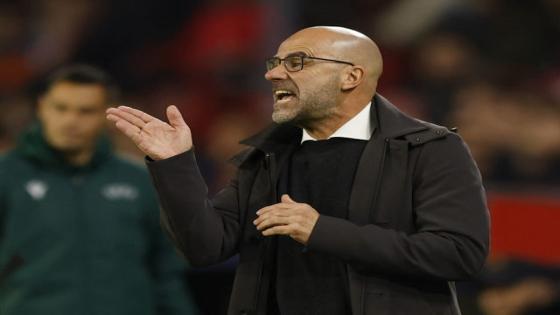
Erik ten Hag stood stock still after Victor Torp tucked away the goal that appeared to have completed a Coventry City comeback, a Manchester United capitulation and what would have been one of the most momentous results in the 153-year history of English football’s oldest competition.
If he had noticed Haji Wright straying offside in the build-up and was simply waiting for VAR to overturn a marginally incorrect on-field decision, then he showed more composure and cool-headedness in those moments than his players had over the previous hour.
Rather, what it looked like was a man incapacitated by the magnitude of what he was witnessing, drowning in the consequences of his side’s collapse, and resigned to a defeat that would all but settle the debate over his future. To all intents and purposes, it looked like the end.
Instead, there was a reprieve. Coventry manager Mark Robins lamented Wright not cutting his toenails after seeing how marginal the call was. Maybe Wright’s toenail will be the modern day Mark Robins moment, the turning point in the career of a United manager.
But even once the technology had pulled United back from the brink, even once they edged through a penalty shoot-out, this felt less a turning point and more a tipping point.

Avram Glazer, Sir Jim Ratcliffe and Sir Dave Brailsford watch United’s toils at Wembley (Marc Atkins/Getty Images)
Maybe that is an overly pessimistic way of reading Ten Hag reaching his second FA Cup final in as many seasons — an occasion that will be a repeat of last year’s derby against Manchester City. “A huge achievement,” was how he described that feat. “The last 20 years, United was in the final five times. Now two in two years.”
But the pessimistic reading is also the more realistic one. The only positives it was possible to take from this collapse from 3-0 up to parity with a side eighth in the Championship were that United could still arguably salvage this campaign and that Ten Hag could still feasibly salvage his job by winning a trophy.
And, even then, would an unlikely United victory in the final really make that much of a difference? Should it? Especially after a semi-final where familiar problems left Ten Hag’s side on the precipice of a disaster.
It cannot help Ten Hag’s cause that this total collapse and near-total surrender came in front of many of those tasked with deciding whether he stays or goes.
Co-chairman Joel and Avram Glazer were present, neither completely shorn of influence at Old Trafford just yet. Jason Wilcox, United’s new technical director, was also in attendance for the first time and will have a significant input into decisions this summer, especially while negotiations over Dan Ashworth’s release from Newcastle United drag on.
But the most significant presence was that of Sir Jim Ratcliffe, fresh from running the 26.2 miles of the London Marathon. The septuagenarian made his way around the course in 4:30:52 before hot-footing it to Wembley with just enough time for a short, impromptu interview with the BBC in between.
Ratcliffe was asked how the pain and strain of running the marathon compared to that of running a football club. “There are some parallels, I have to say,” he replied. “It just sort of requires some grit. Always in the marathon, after 30km, it gets quite difficult. I don’t think we’re quite at 30km with the football yet.”
How far along are United, then? A half marathon’s worth? “No, we’re not really there yet. The first 10km. It’s a long journey really, the football.”

Ratcliffe completed the London Marathon earlier in the day (John Walton/PA Images via Getty Images)
You imagine it did not help Ten Hag’s cause that Ratcliffe arrived in time for the second half. Ironically, had he been in place for the first 45 minutes, he would have witnessed one of the few times this season United have approached a game as a marathon rather than a sprint.
After running into the lead through Scott McTominay, United’s play was composed and controlled in a way rarely seen of late. On one potential counter-attacking opportunity, Bruno Fernandes passed up the chance to play forward quickly and instead elected to put his foot on the ball, allowing United to retain possession and keep control.
It could never last. United can bemoan the bad luck of Callum O’Hare’s deflected shot for the second or the decision to award a late penalty against Aaron Wan-Bissaka for a handball he could do little about, but all three of Coventry’s goals came through an absence of game management, something that has repeatedly let United down in recent weeks.
Since the quarter-final against Liverpool, United have given up 1-0, 3-2, 2-1 and 3-0 leads. Ten Hag has seen his players concede seven goals in the 90th minute or beyond since the start of February. Not since 1962-63 have United conceded three goals or more in as many games as they have this season.
As for Ratcliffe, he has finally witnessed his first United win, of sorts, having previously only been present for draws and defeats against Tottenham Hotspur, Chelsea and Liverpool. And yet this victory will colour perceptions of the manager far more than any of those other games did due to the stage, the standard of opposition but, most of all, the scale of the collapse.

Ten Hag attempts to rally his troops ahead of the penalty shootout (Matthew Peters/Manchester United via Getty Images)
Ten Hag’s future remains in the balance, although at any club to have changed its chief executive, director of football and technical director in a matter of months, the manager would be in a precarious position.
And while watching Ten Hag attempt to encourage and rally his players after Torp’s winning goal was disallowed, it felt like a premonition as much as it did a reprieve.
After all, a little more than a month from now, it is not difficult to imagine another swarm of sky blue tearing through an overwhelmed defence, bearing down on a Wembley goalmouth and applying the finish that would put this maddening United season and perhaps their manager beyond saving.
(Top photo: Jacques Feeney/Offside/Offside via Getty Images)