Follow The Athletic’s Olympics coverage here.
The video flickers onto three big screens, grainy footage showing International Olympic Committee (IOC) president Thomas Bach, then a callow 22-year-old, winning his gold medal at the 1976 Montreal Olympics.
“Thanks for showing that I haven’t changed at all,” quips the German, now 70, and the most powerful figure at the IOC after an 11-year tenure which shows no signs of stopping.
The reality, and the reason why he is speaking, is that the Olympic Games themselves are changing.
Earlier this week, it was announced that World Athletics would pay $50,000 (£40,353) for each track and field gold medal in Paris this summer — a first in Olympic history. This Games will see breakdancing introduced while surfing, making its second appearance, will take place almost 10,000 miles away from the host city in Tahiti.
And now at a launch event at London’s Olympic Velodrome, with Champagne handed out from 1pm and a table devoted solely to French pastries, Bach is explaining why the Olympic movement, known for its traditionalism and amateur values, is embracing artificial intelligence (AI).
“We are at a crossroads of change,” he tells the room. “We can only be the leader of change if you take a holistic approach. We are representing the first holistic approach — the Olympic AI Agenda. It is a conceptual and practical approach. It defines our ambition and our guiding principles, embracing the full potential of AI. But at the centre of the agenda is the human. The athlete.”

Bach delivers the closing speech at the Olympic AI Agenda event in London (Ben Stansall/AFP via Getty Images)
Unlike other areas, he theorises, sport does not face an existential question — “the 100m will always have to be run by an athlete” — meaning they are free, as administrators, to develop the technology to support participants. “Embrace the change,” is the final line of his opening address, “but retain Olympic values.”
As his words die away to a smattering of applause, alpine skier Lindsey Vonn, one of the United States’ most famous Winter Olympians, limps onto the stage. Her latest knee surgery, suitably, has been performed by a robot.
She has been invited to talk about AI’s role in talent identification. Despite being born in the relative flatness of Minnesota, hers was a skiing family and her talent was recognised at an early age. She benefited from access to further support and coaching. That, she openly admits, was fortunate. Now, they hope to use AI to test children in developing nations to find sports for those with raw but transferable athletic abilities.
Last year, the IOC visited Senegal carrying hardware equipment for both physical and cognitive tests. Outside the velodrome, suppliers Intel have brought a larger-scale, futuristic version. In Senegal, the team visited six villages over six days, testing 1,000 children of whom 40 were deemed to have “superb” ability — the raw potential to perhaps compete in the Olympics.
One child recorded numbers in several tests comparable to those in the national sprint team.
“I think it’s going to be a huge opportunity,” says Vonn. “So many kids quit sports early because they don’t know they’re talented, or their coaches don’t believe it. This will prove these kids can be something.”
“It would prove to my Dad that I’d have been an amazing tennis player,” she adds, joking. “I actually don’t like the cold. I’m very jealous.”

Vonn speaks at the AI event (Ben Stansall/AFP via Getty Images)
While intending to improve accessibility, with capacity currently limited, one of the key questions the IOC are wrestling with is how to achieve equality of accessibility between interested federations.
“All the solutions which will be developed will be made available for everyone,” Christophe Dubi, executive director of Paris 2024, tells The Athletic. “That sense of solidarity is very important. You can’t create discrimination through technology.”
The same focus on accessibility is pushed throughout a presentation on athlete performance, led by two-time Olympic triathlon gold medalist Alistair Brownlee and shooter James Huckle, who began building ballistics models using AI while training for the 2012 Games.
Using ChatGPT, the most powerful widely available AI tool, both discussed the possibility of athletes gaining cheap access to sports psychology or allowing ChatGPT to perform the data analysis, taking the time-consuming process out of the hands of the coach who can then focus on the human element. Could this also, one day, be used to help anti-doping efforts?
“If you consider that AI is able to deal with a greater number (of cases) and analyse them much, much quicker than we ever could, there is no reason why anti-doping would not benefit,” says Dubi. “I’m certain that WADA (World Anti-Doping Agency) is thinking about bringing in AI.”

Dubi (left) speaks next to Kevin Walsh, managing partner at Deloitte (BEN STANSALL/AFP via Getty Images)
At the top end of athlete performance, there is also technology in development which could revolutionise training methodology, particularly in one-vs-one sport. For example, using data provided by the Alibaba Cloud, the IOC have constructed table tennis technology which mimics the style of two-time gold medallist Xu Xin.
Players can play against themselves — as Xin already has — or, more intriguingly, one day face potential opponents.
“There are going to be risks associated with this,” says Huckle, sounding a note of warning. “But it’s going to be powered by the human and led by that development. In sport, there is not too much (to worry about), but we have to be aware of the data which these models have been trained on.”
Nadia Comaneci is on stage. The Romanian gymnast is an iconic figure after scoring the first-ever perfect 10.0 at the 1976 Olympic Games.
“Would you have been better with this technology?” she is asked.
“Probably not,” comes the instant reply.
With current technology, would she have been given that perfect 10.0?
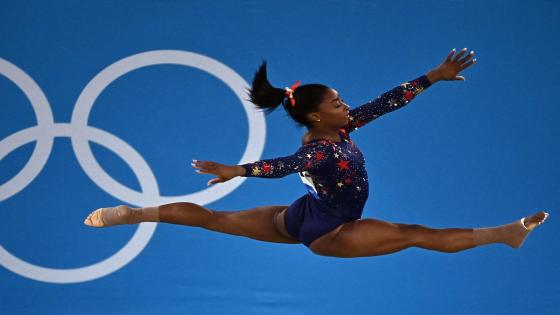
Comaneci is there to discuss the use of AI in judging — probably the most immediately controversial aspect of the agenda. Simone Biles, returning to the Olympics as the most-decorated gymnast of all time, might need a machine’s approval if she is to increase her lead.
The IOC will not yet reveal exactly how much AI technology they will use during the Games, but the central message is that it is there to augment the judging, rather than replace it. Similar language, and aims, were used around the introduction of video assistant referees in soccer.
For example, in trampolining or gymnastics where deductions are given for landing outside the zone, potential indiscretions can be difficult to spot. Diving, focused on entry angles, is another relevant sport. With real-time data, these ‘objective’ points can be instantly reviewed, in theory allowing the judges to focus on more nuanced areas.

Comaneci discussed the use of AI in judging (Ben Stansall/AFP via Getty Images)
“With proper modelling, we can have detailed information of the entire performance of an athlete: their rotation, speed, angles, everything that is crucial for judging,” says Alain Zobrist, the CEO of Swiss Timing, part of Omega, the Games’ official timekeeper. “We can analyse it in sequencing and do all of that in real-time.
“It shows the opportunities and the information which we can share with judges, but also to start understanding these performances much better.”
“When I was competing, we used to have to do compulsory exercises. Everyone had to do the same skill — it would have helped then,” agrees Comaneci. “It shouldn’t eliminate the judging, but it will help a lot. If you do it the right way, you can work out the shoulder locations, whether there should be bonus points… it can help identify details.”
She does, however, point out one drawback: that if the machine is fed one routine to judge, athletes are allowed to enter competitions with a ‘Plan B’ in the back of their minds, which they may opt to switch to mid-performance. Not that legislating for that seems an insurmountable obstacle.
If judging is the area with the most immediate scope for controversy, there are other more subtle issues about which critics are concerned.
Despite an in-depth discussion of safeguarding and security, there was no mention of the Games’ controversial surveillance programme which will utilise AI technology. Approved ahead of the summer, France will now be the first nation in the European Union to allow biometric surveillance systems.
France has faced terrorist attacks in recent years — most notably the IS-coordinated attacks in 2015 which targeted venues such as the Stade de France and the Bataclan music venue, killing 131 people — but the potential implications of this technology have been questioned by human rights groups.
A group of them, including Amnesty International and Human Rights Watch, wrote in French newspaper Le Monde that it was “a worrying precedent” leading to “unjustified and disproportionate surveillance in public spaces, to the detriment of fundamental rights and freedoms”.
In a discussion about AI, this issue was conspicuous by its absence. Taking questions after the event, Bach would not comment on the issue.
“Security is the authority of the host country,” he said. “We don’t have the skills and the means to make a judgement on the best tools to secure the games. But we have seen from the French government and from the authorities that the efforts to ensure security in Paris are very professional.”

Preparations are well underway in central Paris as the city prepares to stage the games (Victoria Valdivia/Hans Lucas/AFP via Getty Images)
Earlier in the week, Dubi told The Athletic that the IOC had learned from security issues in Paris ahead of the 2022 Champions League final, and insisted on Friday that these security measures were not problematic.
“The main concern from the French public was that facial recognition would allow for an individualisation of the information,” he said. “I think it has to be made clear that the only thing that will be done with smart cameras this summer is to look at behaviours, and patterns of behaviours. It is about how we can keep these huge crowds safe, up to 500,000 (in the centre of Paris), but without individual recognition.”
Nevertheless, the issue demonstrates the risks at play. Oxford academic Andrew Stephen, part of the AI working group, underscores this. “We’re in new uncharted territory here,” he explains. “What works? What doesn’t work?”
“It’s going to go at warp speed, in my opinion,” adds fellow working group member Amit Joshi, a professor in AI at the International Institute for Management Development (IMD).

Bach, centre, and the panellists (IOC)
The IOC feel a need to jump in early — though they repeatedly stress that the real fruits of their research will be borne out in future Olympic cycles. For them, this is just the start.
“It will be a long journey,” says Bach in his closing remarks. “This isn’t about the 100m sprint, it’s about an Olympic marathon. We don’t know what will happen tomorrow, it will accelerate day by day… (but) we have to ask ourselves every day whether the assumptions we hold are correct.”
Bach’s choice of verbs is revealing. The IOC “need to explore the potential benefits”, they “want everyone to join this marathon with us”.
Halfway through his final speech, the microphone of Bach’s lapel breaks. He is given a traditional microphone.
There is a little way to go yet.

GO DEEPER
100 days until the Olympic Games – is Paris ready?
(Photo: Lionel Bonaventure/AFP via Getty Images)


