Another Toronto Maple Leafs regular season has come and gone. With a retooled roster, the team took a step back from their previous two campaigns and finished third in the Atlantic Division with a 46-26-10 record.
By now, you know the drill: Any success the Leafs had in the regular season won’t compare to how they perform in the playoffs. Yet until their first-round series begins against the Boston Bruins, it’s still worth examining how players across that roster performed over 82 games. Multiple Leafs had the best seasons of their careers, others took impressive steps in their development and some now have question marks hovering over their Leafs futures.
This season, we’ve tasked Joshua Kloke and James Mirtle to hand out letter grades for the entirety of the roster. Players are listed by position and in order of ice time per game. Grades are awarded based on factoring in expectations, role and salary.
Forwards
Mitch Marner: B
This wasn’t Marner’s best season, but that’s in part because of how high of a bar he has set in regular seasons past. He missed 13 games due to injury and started the season slowly by his standards, but by season’s end, his points-per-game matched that of his record 99-point campaign of 2022-23.
A lot of that production came in the second half, as he piled up 47 points over his final 34 games, putting him top 10 leaguewide in PPG in that stretch. Curiously, Marner wasn’t nearly as dominant defensively as he’s shown in the past, likely owing to both a tough start and the undisclosed injuries he dealt with.
Auston Matthews: A+
What other grade can you give to the Leafs’ best player, who didn’t just have the best season of his career but arguably one of the best seasons by a goal scorer in, y’know, NHL history? When Matthews has been on his game this season, the Leafs have had a chance to win every outing.
Matthews might not win the Hart Trophy, but the list of reasons why he should win it is still a long one.

GO DEEPER
Auston Matthews kinda has to be the MVP — doesn’t he?
He’s become even more reliable and effective defensively, and then there’s the matter of him scoring more goals than any other player since 1995-96. Sheer dominance night after night.
William Nylander: A-
Nylander had almost the reverse year of Marner: He started blazing, with a 17-game point streak to open the year and a 1.5 points-per-game pace over the first 38 games of the season (putting him tied for third in league scoring at that point in early January).
Nylander cooled considerably late in the year, including a frustrating one-goal-in-13-games stretch to end the season. His defensive game was also a bit all over the place, with flashes of dominance followed by struggles to stay fully engaged.
In all, however, the season marked a step forward, with a career-high 98 points and an average ice time mark of 20 minutes for the first time.
John Tavares: B-
It’s a well-worn cliche for a reason: Father Time remains undefeated. Tavares turned 33 in training camp and struggled offensively for long stretches of the season, putting up his lowest points-per-game mark since his rookie season 14 years ago.
Producing only 65 points while making $11 million is obviously a bit tough for the captain, but Tavares has made strides to improve defensively and remains an ace in the faceoff circle. He was also a bit snakebitten, with the lowest shooting percentage of his career, so it’s possible he can bounce back a bit next year in the final season of his seven-year contract. But those 35-goal, 80-point days appear gone.
Tyler Bertuzzi: B-
Bertuzzi has had a decent enough season when you add it all up. Sure, he struggled to find his footing in Toronto and in the lineup early on and had serious dips in his production. But in the second half of the season, he has moved way better, looked more comfortable playing up and down the lineup and scored the kind of greasy, net front goals he needs to score come the postseason. When he’s bringing all those elements and adding a layer of peskiness, he can change the tempo of the game.
There are a few players on this list who will be under more of a microscope come the postseason and Bertuzzi is high on that list. But if we’re judging him on the regular season, his game picked up right when it needed to.

GO DEEPER
‘He doesn’t like to lose’: Tyler Bertuzzi was made to play in big games
Calle Jarnkrok: B-
A bit of a hard one to evaluate given how much time Jarnkrok missed with injuries (30 games). That said, it was noticeable how much the Leafs missed his dependable two-way play when he was out, and his $2.1 million cap hit remains a bargain. He’s been relatively healthy throughout his career, so we’ll consider his drop in offence a product of bad luck.
Max Domi: B
Domi really hit his stride in the second half of the season when he moved to the wing (probably his better position) and began producing more regularly and showing off the snarl that’s always been a hallmark of his game. Playing with one of the lowest ATOIs of his career, he still dished the puck to the right areas of the ice with regularity and notched the fifth-most 5-on-5 assists in the NHL.
Even if there were some questionable penalties along the way, you can’t fault Domi for bringing the passion many hoped he’d employ. Few Leafs love being in the spotlight like Domi, and you could tell as the playoffs drew closer and he spent time on the top line.
Matthew Knies: B-
Knies’ rookie season largely met expectations. He finished with 15 goals, good for seventh among rookies and as the season progressed, Knies became more comfortable throwing his 6-foot-3 frame around.
On the flip side, Knies experienced the kind of bumps many rookies do: He’s learned about NHL officiating the hard way, taking the third-most minor penalties of any Leaf. He’s been caught out of position defensively more than both he and coach Sheldon Keefe would probably like.
Overall, there was enough reason for promise in Knies’ season to suggest he’ll become a full-time top-six forward down the road.
David Kampf: C-
Not a great showing on the four-year, $9.6 million deal he signed in the offseason. Kampf’s line struggled mightily early in the year, and his minutes were ultimately pulled back nearly two per night as Keefe searched for defensive reliability elsewhere in his lineup. Never a big offensive producer, Kampf felt particularly inept there this season, with only eight goals and 19 points in 78 games. He also has to wear at least some of the herculean struggles for the Leafs PK this season.
Connor Dewar: B
With only 17 games played as a Leaf after coming over at the trade deadline, Dewar nonetheless has shown an ability to be an effective member of an energy line in short order. His relentless work ethic translates into strong results defensively, which helped boost what had been a largely identity-less fourth line until late in the year. Only 24 years old and already with nearly 200 NHL games under his belt, Dewar has some upside potential to become a capable worker bee down the lineup for the next few years.

GO DEEPER
From The Pas to Toronto: Inside Connor Dewar’s remarkable journey to the Maple Leafs
Bobby McMann: B+
McMann scores well here because he completely surpassed expectations. He felt like a depth forward, or even a Toronto Marlie, entering the season but instead propelled himself with constant energy, forechecking and a vital goal-scoring streak into a lock for the playoff lineup if he’s healthy. His 15 goals in just 56 games is nothing to sneeze at, especially considering he earned a paltry $762,500 this season.
At 27, McMann finally fighting his way into the lineup (he wasn’t even supposed to be in the lineup the day he scored his first NHL hat trick) is an example of perseverance almost every player could learn from.

GO DEEPER
Why the Maple Leafs inked Bobby McMann to a two-year extension: ‘He’s blossoming’
Pontus Holmberg: B-
You can see flashes of something more there in Holmberg. He ended the season with just seven goals while averaging only 11 minutes a night, but he can play all three forward positions and has some more offensive ability buried in a capable two-way game. A sixth-round pick who is the definition of a late bloomer, Holmberg still needs to get better on the draw and in tougher minutes to make more of an impact.
Noah Gregor: C
A feel-good story when he made the Leafs off a PTO in training camp, Gregor came flying out of the gate, using his impressive speed to beat defenders and eat some minutes on the penalty kill. But he faltered later in the year and has been in a battle to get into the lineup after the deadline.
One goal and five points in 35 games to close the year means he’s going to be on the outside looking in when the playoffs start – and likely in for a battle for an NHL contract again in the fall.
Nick Robertson: B
Robertson stayed healthy all season, which means a job well done for him. That he scored 14 goals in 55 games with boatloads of energy is part of what makes him such an intriguing forward for the Leafs. If Robertson can become more defensively responsible, he might earn the full trust of the coaching staff. That feels like the next – and sizeable – hurdle he has to clear in his NHL career.
Ryan Reaves: C+
Imagine we were handing out grades midway through the season? Would any player on this list have the variance in his grade like Reaves?
Though he was more than willing to drop the gloves at the beginning of the season (and that’s what he was expected to do) he didn’t contribute anything else to the lineup. Without any pace in his game whatsoever, his future as a Leaf was in question.
But from February onward, Reaves transformed his game. The hours he spent after practice learning how to be more effective with the puck paid off. He still chucked knuckles with regularity, but he brought more energy on the forecheck to help set up top six lines when they would hop over the boards. Let’s see if he sets the tempo as expected when the intensity heightens come playoff time.

GO DEEPER
Behind Ryan Reaves’ remarkable midseason turnaround for the Leafs
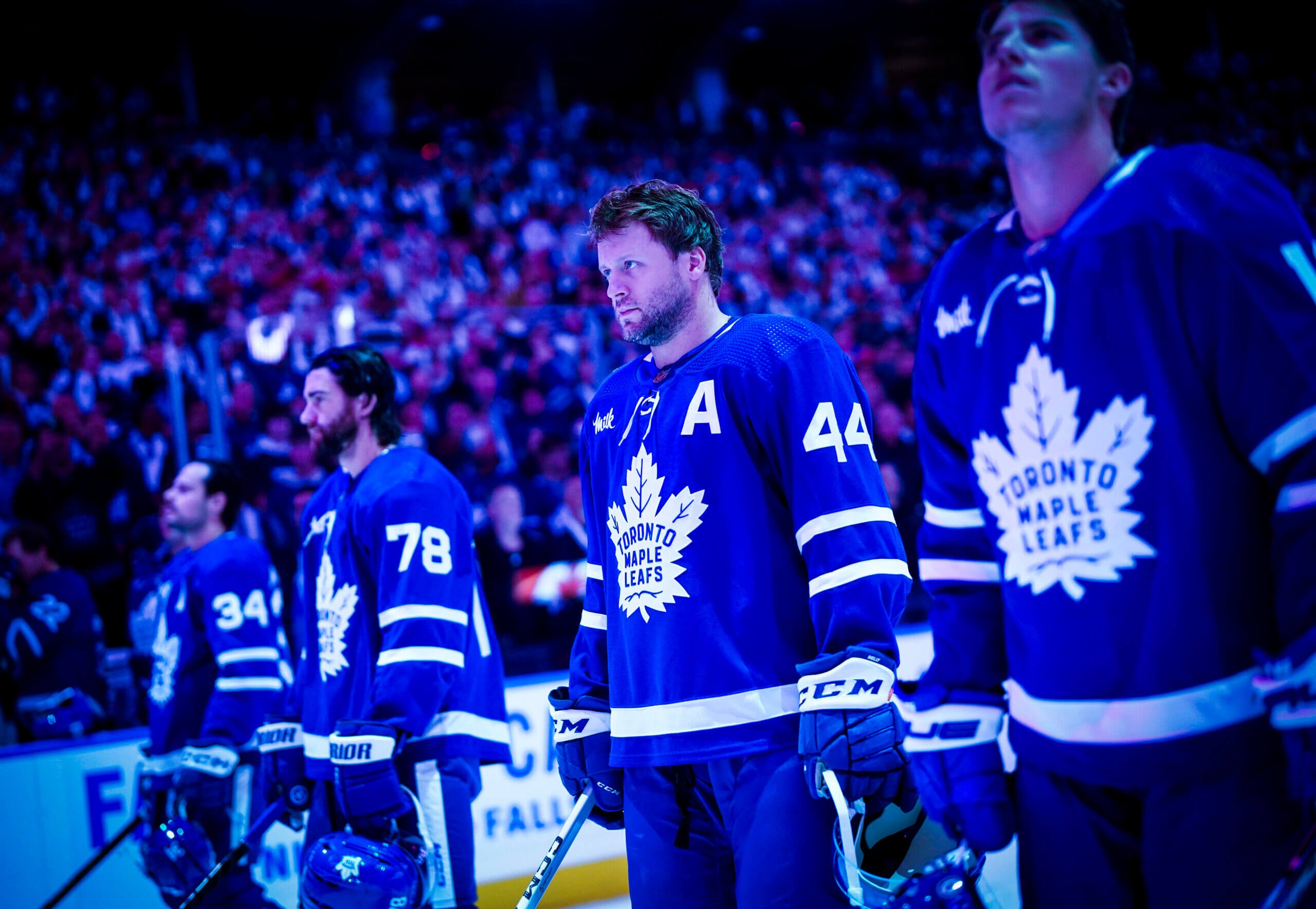
Morgan Rielly is an important part of the Maple Leafs potent offence. (Mark Blinch / NHLI via Getty Images)
Defencemen
Morgan Rielly: B
Despite missing 10 games, Rielly finished his season 11th among defencemen in the NHL in scoring, highlighting just how big a piece he is of the Leafs potent offence. His penchant for giving some of that back continues to be a frustration point, but Rielly has shown again and again an ability to elevate his play in key moments and big games.
And even with his uneven defensive game, the good continues to outweigh the bad, which is why Keefe has him out there 24 minutes a night, every night.
TJ Brodie: D
One of the Leafs’ most dependable players for three years since signing in Toronto, Brodie has been in one all season. Still averaging nearly 22 minutes a night and facing top competition, he has lost a step and struggled to skate his way out of the trouble the way he has for so many years. His falloff has been one of the biggest reasons for the Leafs defensive decline this season; whether he can find his game, likely on the left side, in the postseason is a key question Keefe will have to answer quickly.
Jake McCabe: A-
What a step McCabe took in 2024 in Toronto compared to last season when he was dealt to the Leafs at the trade deadline. There were points when McCabe’s composure meant he looked like the Leafs’ best blueliner. He blended the kind of nastiness and clean puck movement the team often lacked in the back. A bet on him playing better in the playoffs in 2024 compared to 2023 is a safe one.
John Klingberg: Incomplete
There’s no question Klingberg was brutal in his brief tenure as a Leaf. But he was also playing through a significant injury, which is what led to him being shut down in mid-November for hip surgery. This one was a miss by the front office, but it’s hard to blame a player who hasn’t looked anything like his top-pair-leading former self the past few seasons.
Timothy Liljegren: C+
Injuries hampered Liljegren’s season as he was on the way up. He played just 55 games. The long streaks of good games just weren’t there.
Joel Edmundson: B-
Injuries have limited the veteran trade deadline acquisition to just nine games so far as a Leaf. The minutes he has played in Toronto have been a mixed bag, with his impressive physical presence obvious in a win over Edmonton, but his skating and puck skill deficiencies also evident at times. Still, if he can get healthy, Edmundson very easily could be an X-factor on the back end in a long playoff series.
Simon Benoit: B+
During training camp, who had Benoit not finishing the season with the Marlies but becoming a cult hero in Toronto and earning a three-year extension?
For the low, low price of $775,000 this season, Benoit won over the hearts of Leafs fans by throwing punishing hits and sticking up for teammates, all with a smile beneath his milk moustache. The consistency in his game has eventually made him more of a lock for the playoff lineup.
Ilya Lyubushkin: C
Lyubushkin played well right after the acquisition, but his game has since fallen off. He’s at his best when you don’t notice him; when you do, it’s often a turnover off of his stick coming out of the D zone. The Leafs are likely going to have to shelter him in the playoffs. Whether or not he’s one of their best six options on the back end remains a real question.
Mark Giordano: C+
The oldest player in the league by almost a full calendar year emptied the tank in the 46 games he played. He’s not the impact player he was when he won the Norris five years ago, but Giordano’s presence in the Leafs dressing room was a positive all year. And the way he battled through injuries and the death of his father was commendable. If this is the end, what a career.
Conor Timmins: C
Timmins’ underlying numbers were impressive this season (a team-high 61 percent 5-on-5 expected goals) as he battled injury and an illness and played just 24 games. There were flashes of his high hockey IQ that can change a game, but even more development is needed to round out his game.
Goalies
Ilya Samsonov: C+
A really tough one to grade given all the seasons there were within the season for Samsonov. Coming off a breakout 2022-23 campaign where he established himself as the Leafs clear No. 1, he faceplanted early in the year, posting an .862 save percentage in 15 games in the first half and ended up on waivers. And despite a handful of teams around the league needing goaltending help, he went unclaimed.
Give Samsonov full marks for battling back from that low point: He’s posted an 18-5-2 record so far in 2024 and is expected to be the Leafs’ Game 1 starter to open the playoffs. But he still has a lot to prove – and it may not take much of a falter for someone else to get into the crease this postseason.

GO DEEPER
‘Maybe I’m done’: Inside Ilya Samsonov’s break from the Leafs that got his career back on track
Joseph Woll: B-
It’s still worth wondering what could have been for Woll had he not suffered a high ankle sprain in a Dec. 7 win over the Ottawa Senators. In his first full NHL season, he was showing high levels of both athleticism and maturity to make him look like he could have claimed the Leafs No. 1 job.
Woll returned from injury two-and-a-half months later. In his 10 starts since that return, he just didn’t look as sharp. And he certainly didn’t hit the highs he did in the first half of the season, giving up four or more goals in five of those starts.
He’s still the goalie of the future for the Leafs. His path to getting there just took a few unexpected detours this season.
Martin Jones: B+
The Leafs ended up needing their third goalie in a big way and Jones delivered by winning 11 of his 19 starts. At his best, Jones was never flashy but covered the net well enough and provided enough veteran confidence to the team in front of him. When you look back at how he kept the team afloat by allowing just three goals through four games in early January (including playing both nights of a back-to-back) you can’t help but feel good for the 34-year-old.
(Top photo: Mark Blinch / NHLI via Getty Images)